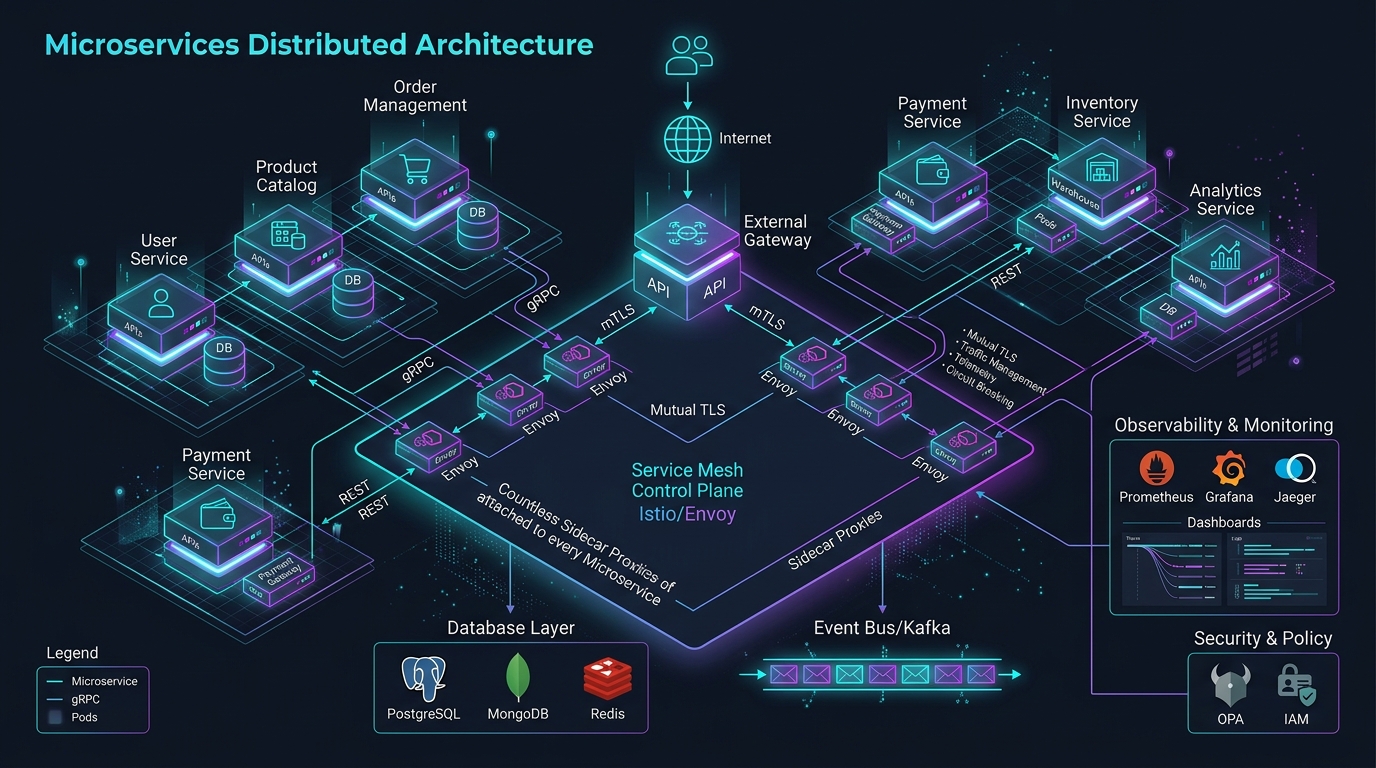
Banking Microservices in Go: Saga & Event Sourcing
Answer-First: Banking microservices architecture in Go enforces strict bounded context isolation, double-entry immutable ledgers, and distributed Saga orchestration to guarantee zero financial data loss. By combining optimistic concurrency control, transactional outbox event streams, and SPIFFE/SPIRE zero-trust mutual TLS, financial platforms process over 10,000 TPS while maintaining sub-10ms latency and strict PCI-DSS v4.0 regulatory compliance.
Prerequisite: Readers should possess solid foundations in relational database transactions (ACID, isolation levels, row locks), distributed systems primitives (Saga patterns, outbox pattern, idempotency keys), and Go concurrency patterns (goroutines, contexts, connection pooling).
1. Introduction: Deconstructing the Legacy Core
Legacy banking platforms like Temenos T24 and Oracle FLEXCUBE were designed as rigid transactional monoliths for batch processing. Digital banking now requires decomposing these into event-driven microservices capable of real-time payments with sub-10ms latency.
Migrating to a microservices architecture means dismantling these bottlenecks:
- Scaling limitations: Monoliths scale vertically (costly hardware), while microservices scale horizontally.
- Release cycles: Legacy cores require massive, risky quarterly releases. Microservices enable independent deployments.
- Data locking: Central databases in monoliths create severe lock contention during high-velocity events (like payday processing).
By leveraging Go’s highly concurrent runtime and a distributed event-driven architecture, we optimize the system for <10ms database writes at 10,000 TPS, ensuring scalability and fault tolerance.
2. Domain Decomposition: Mapping Core Banking Contexts
Apply the Strangler Fig pattern alongside DDD to decompose a core banking monolith. Define explicit bounded contexts for Accounts, Payments, and Ledger, isolating legacy data structures behind Anti-Corruption Layers.
The domain architecture diagram shows how banking microservices decouple from legacy core systems via an Anti-Corruption Layer (ACL):
graph TD
    API["API Gateway"] --> Accounts["Accounts Service - CASA"]
    API --> Payments["Payments Routing Service"]
    Payments --> Ledger["Ledger Service"]
    Accounts --> Ledger
    Ledger --> Notifications["Notification Service"]

    subgraph Legacy Core
        ACL["Anti-Corruption Layer"]
        T24["Temenos T24"]
        ACL --> T24
    end

    Ledger -.Sync.-> ACL
Each service owns its database. The Ledger Service never queries the Accounts database directly; instead, it subscribes to immutable state change events.
3. Event Sourcing: Designing the Immutable Double-Entry Ledger
An immutable financial ledger replaces mutable balance columns with append-only event streams logging every credit and debit. This guarantees full audit compliance, eliminates race conditions during concurrent updates, and provides a mathematically verifiable transaction history.
PostgreSQL Write Model DDL
Core event stream and event log tables in PostgreSQL, enforcing Optimistic Concurrency Control (OCC) at the event stream level:
CREATE TABLE ledger_streams (
    stream_id UUID PRIMARY KEY,
    version BIGINT NOT NULL,
    updated_at TIMESTAMP WITH TIME ZONE DEFAULT CURRENT_TIMESTAMP
);

CREATE TABLE ledger_events (
    id UUID PRIMARY KEY DEFAULT gen_random_uuid(),
    stream_id UUID NOT NULL REFERENCES ledger_streams(stream_id),
    version BIGINT NOT NULL,
    event_type VARCHAR(100) NOT NULL,
    payload JSONB NOT NULL,
    created_at TIMESTAMP WITH TIME ZONE DEFAULT CURRENT_TIMESTAMP,
    CONSTRAINT uq_stream_version UNIQUE (stream_id, version)
);
The OCC Append Transaction in Go
When appending an event, the system checks the expected_version within a database transaction. Using pgx/v5:
// Go repository query using pgx/v5
tx, err := pool.Begin(ctx)
if err != nil {
    return err
}
defer tx.Rollback(ctx)

// 1. Verify and update version
res, err := tx.Exec(ctx, `
    UPDATE ledger_streams
    SET version = $1, updated_at = NOW()
    WHERE stream_id = $2 AND version = $3`,
    expectedVersion+1, streamID, expectedVersion)
if err != nil {
    return err
}
if res.RowsAffected() == 0 {
    return ErrConcurrencyConflict // Version has changed since read
}

// 2. Insert Event
_, err = tx.Exec(ctx, `
    INSERT INTO ledger_events (stream_id, version, event_type, payload)
    VALUES ($1, $2, $3, $4)`,
    streamID, expectedVersion+1, eventType, payloadJson)
if err != nil {
    return err
}

return tx.Commit(ctx)
To optimize the Go runtime for <10ms database writes at 10,000 TPS, we utilize a transaction-mode PgBouncer pool, NVMe storage, and synchronous_commit = off (when business rules tolerate minimal crash delta). For deeper implementation details, read our guide on double-entry ledger design.
Production-Grade Double-Entry Schema
While event sourcing captures the state transitions, a true double-entry ledger requires strict balance verification constraints across asset, liability, equity, revenue, and expense accounts. In double-entry bookkeeping, every financial transaction must have at least one debit and one credit, and the total debits must exactly equal total credits.
Here is the production-grade PostgreSQL DDL for a normalized, high-performance double-entry ledger. This schema utilizes check constraints to enforce non-negative values and trigger functions to ensure transaction-level balance invariants.
-- Enforce account categories
CREATE TYPE account_class AS ENUM ('ASSET', 'LIABILITY', 'EQUITY', 'REVENUE', 'EXPENSE');
CREATE TYPE entry_direction AS ENUM ('DEBIT', 'CREDIT');

-- Core Accounts table representing the chart of accounts
CREATE TABLE accounts (
    id UUID PRIMARY KEY DEFAULT gen_random_uuid(),
    code VARCHAR(50) UNIQUE NOT NULL,
    name VARCHAR(255) NOT NULL,
    class account_class NOT NULL,
    currency CHAR(3) NOT NULL DEFAULT 'USD',
    created_at TIMESTAMP WITH TIME ZONE DEFAULT CURRENT_TIMESTAMP
);

-- Journal Entries act as the transactional envelope (header)
CREATE TABLE journal_entries (
    id UUID PRIMARY KEY DEFAULT gen_random_uuid(),
    reference_id UUID UNIQUE, -- External transaction reference (idempotency link)
    narration TEXT NOT NULL,
    posted_at TIMESTAMP WITH TIME ZONE NOT NULL DEFAULT CURRENT_TIMESTAMP,
    created_at TIMESTAMP WITH TIME ZONE DEFAULT CURRENT_TIMESTAMP
);

-- Ledger Lines represent individual postings (lines) within a journal entry
CREATE TABLE ledger_lines (
    id UUID PRIMARY KEY DEFAULT gen_random_uuid(),
    journal_entry_id UUID NOT NULL REFERENCES journal_entries(id) ON DELETE CASCADE,
    account_id UUID NOT NULL REFERENCES accounts(id),
    amount NUMERIC(20, 4) NOT NULL CHECK (amount > 0),
    direction entry_direction NOT NULL,
    -- Simple hash chaining column for tamper-evident auditing
    line_hash BYTEA,
    created_at TIMESTAMP WITH TIME ZONE DEFAULT CURRENT_TIMESTAMP
);

-- Create compound index for fast ledger line reconciliation and account balance calculation
CREATE INDEX idx_ledger_lines_account_posted ON ledger_lines(account_id, created_at DESC);
CREATE INDEX idx_ledger_lines_journal_entry ON ledger_lines(journal_entry_id);
To enforce the double-entry invariant (sum of debits equals sum of credits within a transaction), we use a deferred constraint check or a statement-level trigger. Below is the PostgreSQL trigger function that verifies balance integrity before committing:
CREATE OR REPLACE FUNCTION verify_journal_entry_balance()
RETURNS TRIGGER AS $$
DECLARE
    v_debit_sum NUMERIC(20, 4);
    v_credit_sum NUMERIC(20, 4);
BEGIN
    -- Calculate sum of debits and credits for the current journal entry
    SELECT
        COALESCE(SUM(amount) FILTER (WHERE direction = 'DEBIT'), 0),
        COALESCE(SUM(amount) FILTER (WHERE direction = 'CREDIT'), 0)
    INTO v_debit_sum, v_credit_sum
    FROM ledger_lines
    WHERE journal_entry_id = NEW.journal_entry_id;

    IF v_debit_sum <> v_credit_sum THEN
        RAISE EXCEPTION 'Double-entry balance mismatch for journal entry %. Total debits (%) must equal total credits (%).',
            NEW.journal_entry_id, v_debit_sum, v_credit_sum;
    END IF;

    RETURN NEW;
END;
$$ LANGUAGE plpgsql;

-- Apply the trigger as a constraint trigger executed at the end of the statement or transaction
CREATE CONSTRAINT TRIGGER trg_enforce_double_entry
AFTER INSERT OR UPDATE ON ledger_lines
DEFERRABLE INITIALLY DEFERRED
FOR EACH ROW
EXECUTE FUNCTION verify_journal_entry_balance();
Transaction Verification Loops
In high-throughput distributed systems, databases can occasionally suffer from silent data corruption, or application-level bugs might bypass constraint checks (e.g., during database migrations or manual interventions). To mitigate this, modern core banking architectures deploy asynchronous Transaction Verification Loops.
A Transaction Verification Loop is a background service in Go that continuously audits the ledger in slices (e.g., hourly batches) to verify the mathematical invariants and cryptographic signatures of the ledger entries.
Verification Loop Logic
- Mathematical Invariant Audit: The loop executes high-performance analytical queries to ensure that all
ledger_linesgroup byjournal_entry_idsum up to zero (representingdebits - credits = 0). - Hash-Chain Auditing: To prevent malicious database tampering (e.g., an internal actor modifying a transaction amount in SQL), each ledger line stores a cryptographic hash of its content combined with the hash of the preceding line (
line_hashof lineNisSHA256(amount + direction + account_id + journal_entry_id + line_hash_of_N-1)). The verification loop walks this hash chain to verify its integrity. - Reconciliation Loop: It reconciles the ledger-line balances against external records (such as payment gateway reports or Kafka event streams).
Here is a Go implementation snippet of the mathematical audit query run by the verification loop:
type ReconciliationFailure struct {
    JournalEntryID uuid.UUID
    DebitSum       decimal.Decimal
    CreditSum      decimal.Decimal
}

func RunVerificationLoop(ctx context.Context, db *pgxpool.Pool, interval time.Duration) {
    ticker := time.NewTicker(interval)
    defer ticker.Stop()

    for {
        select {
        case <-ctx.Done():
            return
        case <-ticker.C:
            failures, err := auditLedgerInvariants(ctx, db)
            if err != nil {
                log.Printf("Verification loop query failure: %v", err)
                continue
            }
            if len(failures) > 0 {
                for _, f := range failures {
                    log.Printf("CRITICAL: Ledger imbalance detected at journal entry %s: debits=%s, credits=%s",
                        f.JournalEntryID, f.DebitSum.String(), f.CreditSum.String())
                    // Trigger alert, freeze affected accounts, and page on-call engineers
                }
            }
        }
    }
}

func auditLedgerInvariants(ctx context.Context, db *pgxpool.Pool) ([]ReconciliationFailure, error) {
    // Audit the last 2 hours of transactions to catch trailing edge commits
    query := `
        SELECT
            journal_entry_id,
            COALESCE(SUM(amount) FILTER (WHERE direction = 'DEBIT'), 0) AS debit_sum,
            COALESCE(SUM(amount) FILTER (WHERE direction = 'CREDIT'), 0) AS credit_sum
        FROM ledger_lines
        WHERE created_at >= NOW() - INTERVAL '2 hours'
        GROUP BY journal_entry_id
        HAVING COALESCE(SUM(amount) FILTER (WHERE direction = 'DEBIT'), 0) <>
               COALESCE(SUM(amount) FILTER (WHERE direction = 'CREDIT'), 0)
    `
    rows, err := db.Query(ctx, query)
    if err != nil {
        return nil, err
    }
    defer rows.Close()

    var failures []ReconciliationFailure
    for rows.Next() {
        var f ReconciliationFailure
        if err := rows.Scan(&f.JournalEntryID, &f.DebitSum, &f.CreditSum); err != nil {
            return nil, err
        }
        failures = append(failures, f)
    }
    return failures, nil
}
By separating this verification loop from the hot write path, the system maintains ultra-low transaction commit latencies while guaranteeing cryptographic and mathematical proof of ledger correctness within seconds.
4. The Transactional Outbox Pattern: Preventing Dual-Write Failures
Dual-write risks arise when a local database update succeeds but message broker publishing fails due to a network partition. The Transactional Outbox pattern solves this by persisting outbound event payloads atomically within the primary database before an asynchronous relay publishes them to Kafka.
Implementation Architecture
Transactional outbox workflow:
sequenceDiagram
    participant App as Go Service
    participant DB as PostgreSQL
    participant Worker as Outbox Relay
    participant Broker as Kafka

    App->>DB: BEGIN TX
    App->>DB: INSERT ledger_events
    App->>DB: INSERT outbox_events
    App->>DB: COMMIT TX
    Worker->>DB: Poll/CDC outbox_events
    Worker->>Broker: Publish Message
    Worker->>DB: Mark as processed
Go Polling Relay with FOR UPDATE SKIP LOCKED
To safely poll outbox events across multiple parallel Go workers without deadlocks, use PostgreSQL’s FOR UPDATE SKIP LOCKED:
func PollOutbox(ctx context.Context, db *pgxpool.Pool, producer sarama.SyncProducer) error {
    tx, err := db.Begin(ctx)
    if err != nil {
        return err
    }
    defer tx.Rollback(ctx)

    // Lock only returned rows, skip already locked rows by other workers
    rows, err := tx.Query(ctx, `
        SELECT id, aggregate_type, event_type, payload
        FROM outbox_events
        WHERE processed_at IS NULL
        ORDER BY created_at ASC
        LIMIT 50
        FOR UPDATE SKIP LOCKED`)
    if err != nil {
        return err
    }
    defer rows.Close()

    var eventIDs []uuid.UUID
    for rows.Next() {
        var id uuid.UUID
        var aggType, eventType string
        var payload []byte

        if err := rows.Scan(&id, &aggType, &eventType, &payload); err != nil {
            return err
        }

        // Publish to Kafka
        _, _, err = producer.SendMessage(&sarama.ProducerMessage{
            Topic: aggType,
            Key:   sarama.StringEncoder(id.String()),
            Value: sarama.ByteEncoder(payload),
        })
        if err != nil {
            return fmt.Errorf("failed to publish: %w", err)
        }
        eventIDs = append(eventIDs, id)
    }

    if len(eventIDs) > 0 {
        _, err = tx.Exec(ctx, `
            UPDATE outbox_events SET processed_at = NOW() WHERE id = ANY($1)`, eventIDs)
        if err != nil {
            return err
        }
    }
    return tx.Commit(ctx)
}
5. Saga Orchestration: Temporal vs. Dapr for Distributed Transactions
Multi-service payment flows without traditional two-phase commit locks need orchestrated Saga patterns for eventual financial consistency. The key trade-off: Temporal’s dedicated workflow cluster vs. Dapr’s sidecar-embedded engine.
Orchestrator Comparison
| Feature | Temporal | Dapr Workflows |
|---|---|---|
| Core Architecture | Dedicated Server/Worker Cluster | Sidecar (Embedded Durable Task Framework) |
| State Storage | Dedicated DB (Postgres/Cassandra) | Any Dapr State Store (Redis, CosmosDB) |
| Operational Overhead | High (Needs dedicated cluster management) | Low (Reuses existing Dapr infrastructure) |
| Compliance/Audit | Native Archival & History Export (S3) | Requires custom audit logging integration |
| Long-Running Fix | Continue-As-New to avoid event limits | Native Actor state lifecycle |
| Best Fit | Complex, multi-day, mission-critical Sagas | Lightweight, integrated Saga compensations |
Architecture Decision (2026 Core Banking Standard):
- Temporal is required if you need long-term PCI-DSS audit trails, history archival to S3, and process complex multi-day workflows (e.g. mortgage origination). Note that Temporal has a hard event history limit (51,200 events), necessitating the
Continue-As-Newstrategy for infinite financial ledgers. - Dapr Workflows are optimal for short-lived Sagas (e.g. cross-service payment transfers) if you already use Dapr for sidecar routing and pub/sub (understanding Dapr State Store Consistency Trade-offs is critical here).
Go Temporal Workflow Code Structure
Temporal executes compensations natively. The compensation stack defers execution upon transaction failure:
func FinancialTransferSaga(ctx workflow.Context, req TransferRequest) (err error) {
    options := workflow.ActivityOptions{
        StartToCloseTimeout: time.Minute,
        RetryPolicy: &temporal.RetryPolicy{MaximumAttempts: 3},
    }
    ctx = workflow.WithActivityOptions(ctx, options)

    var compensations []func()

    // Defer compensation execution
    defer func() {
        if err != nil {
            for _, comp := range compensations {
                comp()
            }
        }
    }()

    // Step 1: Deduct
    err = workflow.ExecuteActivity(ctx, DeductFundsActivity, req).Get(ctx, nil)
    if err != nil {
        return err
    }
    compensations = append(compensations, func() {
        workflow.ExecuteActivity(ctx, RefundFundsActivity, req).Get(ctx, nil)
    })

    // Step 2: Credit
    err = workflow.ExecuteActivity(ctx, CreditTargetActivity, req).Get(ctx, nil)
    if err != nil {
        return err
    }

    return nil
}
6. Designing Idempotent Payment APIs in Go
Network retries, client timeouts, and duplicate Kafka delivery can cause double-spending if payment endpoints lack idempotency safeguards. The pattern:
- Check: The client sends an
Idempotency-Keyheader. - Lock: The Go API attempts to acquire a lock in Redis using a Lua script (
SET NX). - Database Constraint: For permanent safety, the idempotency key is inserted into a PostgreSQL
processed_transactionstable with aUNIQUEconstraint. If another request attempts to insert the same key, PostgreSQL rejects it.
This resilient mechanism is fundamentally similar to H3 geospatial indexing collisions or Redis caching optimizations—you must assume distributed networks will duplicate data.
7. Observability: OpenTelemetry in Distributed Ledgers
Tracing payment transactions across asynchronous brokers and microservices requires propagating distributed context headers through every event payload.
When using segmentio/kafka-go, native OpenTelemetry middleware is unavailable. Here’s a custom TextMapCarrier to inject/extract trace context into Kafka message headers:
type KafkaHeaderCarrier struct {
    Headers *[]kafka.Header
}

func (c *KafkaHeaderCarrier) Get(key string) string {
    for _, h := range *c.Headers {
        if h.Key == key {
            return string(h.Value)
        }
    }
    return ""
}

func (c *KafkaHeaderCarrier) Set(key, value string) {
    *c.Headers = append(*c.Headers, kafka.Header{
        Key:   key,
        Value: []byte(value),
    })
}

func (c *KafkaHeaderCarrier) Keys() []string {
    keys := make([]string, len(*c.Headers))
    for i, h := range *c.Headers {
        keys[i] = h.Key
    }
    return keys
}
By explicitly passing this carrier during message publishing and consumption, the transaction ID flows continuously through the entire architecture, providing crucial data for incident resolution.
Frequently Asked Questions
Q1: How does Event Sourcing ensure double-entry audit compliance in banking microservices?
Event Sourcing stores every financial operation as an immutable sequence of events (credits and debits) in a ledger stream, rather than updating a mutable balance column. This provides a cryptographically verifiable and irreversible audit trail required by financial regulators.
Q2: Why is the Transactional Outbox pattern required instead of direct Kafka publishes?
If a service updates the database and then directly publishes to Kafka, a network failure during the publish creates a dual-write inconsistency (database updated, downstream services unaware). The Outbox pattern writes the event to the same database in the same transaction, guaranteeing at-least-once delivery.
Q3: How do you design an idempotent payment API in Go to prevent double-charging?
By implementing a Key-Check-Execute pattern. Clients provide an Idempotency-Key. Go checks a Redis cache (via SET NX locks) and enforces uniqueness through a PostgreSQL UNIQUE index constraint on a processed_transactions table to reject duplicate requests.
Q4: What is the performance difference between Dapr and Temporal for banking Saga orchestration?
Temporal requires a dedicated server cluster and provides immense throughput for long-running workflows, but has high operational overhead and history limits. Dapr Workflows embed a Durable Task Framework directly into the application sidecar, reducing gRPC overhead and cluster management, making it faster for simple, short-lived Sagas.
Frequently Asked Questions
Why is double-entry bookkeeping non-negotiable in banking microservices?
How do orchestrated Sagas differ from choreographed Sagas in core banking?
How does the Transactional Outbox pattern guarantee zero message loss during crashes?
outbox database table within the same ACID transaction as the business entity update. A background change data capture (CDC) process or poller reads the outbox table and guarantees that events are published to Kafka at least once.How do banking systems prevent race conditions on high-frequency merchant accounts?
For deeper architectural patterns on structuring clean Go microservices, refer to our comprehensive blueprint on modular Go microservices architecture.