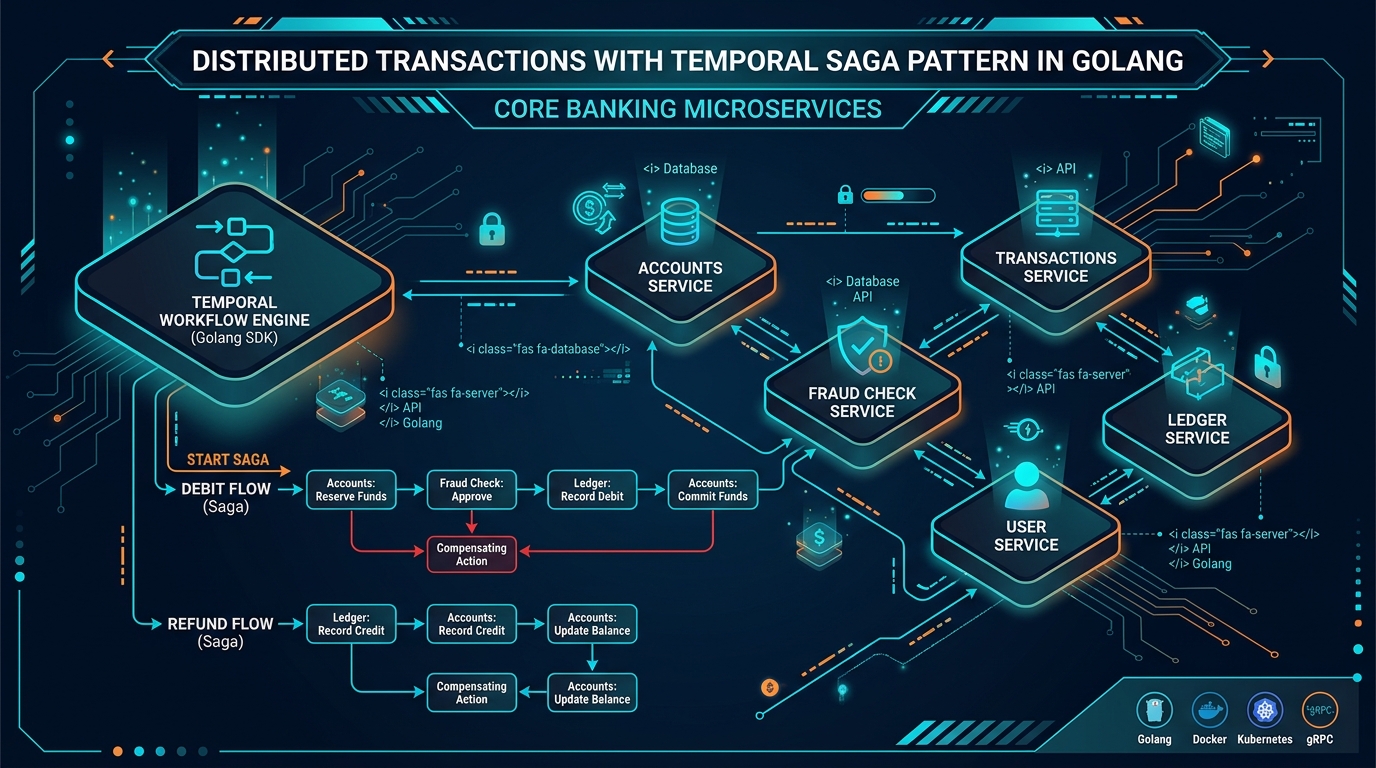
Distributed Transactions in Go with Temporal Saga Pattern
Answer-first: Implementing distributed transactions in Go with the Temporal Saga pattern orchestrates multi-service workflows via code, eliminating blocking Two-Phase Commit locks. By pairing deterministic event-sourced execution with dynamic backward compensations, PostgreSQL transaction outbox deduplication, and exponential activity retries, Temporal guarantees eventual consistency and financial invariants across autonomous microservices during unexpected network partitions.
Prerequisite: Production experience with Go concurrency primitives, distributed microservices architecture, and foundational understanding of ACID transaction isolation levels.
Distributed transactions in Go microservices are commonly implemented using the Temporal Saga pattern: replacing blocking Two-Phase Commit (2PC) locks with imperative workflow orchestration, dynamic reverse compensations (saga.AddCompensation), and PostgreSQL idempotency tables to keep financial event consistency during network partitions. This guide covers:
- The Zombie Activity Pitfall: Why setting
StartToCloseTimeoutwithout database-level idempotency locks causes phantom debits during prolonged TCP network partitions. - Dynamic Compensation Registration: How to structure
workflow.NewSagain Go so that partial failures (e.g., debit succeeds, fraud check passes, but ledger credit fails) only execute compensation for steps that actually mutated state. - Handling Non-Compensable External Side-Effects: Practical design patterns for handling third-party banking APIs (e.g., SWIFT/ACH wires) that cannot be programmatically rolled back.
- Workflow Determinism Invariants: How to write Go workflows that use Temporal signals and queries without triggering fatal non-deterministic replay panic errors.
Section 1: FinTech Distributed Transaction Mechanics: 2PC vs Saga & Dual-Entry Accounting Invariants
In modern distributed financial systems, microservice architectures decompose monoliths into autonomous domains: Account Management, Fraud Detection, Core Ledger, Payment Gateway Integration, and Customer Notifications. While this decomposition provides organizational velocity and independent database scaling, it shatters the traditional ACID guarantees provided by single-instance relational databases.
The Dual-Entry Accounting Invariant
In core banking and payment processors, financial integrity hinges upon the Dual-Entry Accounting Invariant:
$$\sum \text{Debits} = \sum \text{Credits}$$
For any monetary transfer of amount $M$ from Account $A$ to Account $B$, the system must execute two atomic operations:
- Debit Account $A$ by $M$ ($A_{balance} \leftarrow A_{balance} - M$).
- Credit Account $B$ by $M$ ($B_{balance} \leftarrow B_{balance} + M$).
If a system debits Account $A$ but fails to credit Account $B$ due to a network partition, database crash, or service deployment, the system loses money or creates unallocated funds out of thin air. In a monolithic database, a standard SQL transaction (BEGIN TRANSACTION ... COMMIT) handles this atomically via Write-Ahead Logging (WAL) and Multi-Version Concurrency Control (MVCC). In a microservice ecosystem, Account $A$ lives in PostgreSQL Cluster Alpha, while Account $B$ or the Ledger lives in PostgreSQL Cluster Beta. A single SQL transaction cannot span these network boundaries.
Monolithic Transaction (ACID):
[ DB Transaction Start ] ---> [ Debit Account A ] ---> [ Credit Account B ] ---> [ Commit ] (Atomic)

Distributed Microservices (No Native ACID):
[ Service A (DB Alpha) ] --(HTTP/gRPC)--> [ Service B (DB Beta) ]
  └─ Account A Debited                      └─ Network Timeout / Service Crash!
     (State Inconsistent: Account A debited, Account B NOT credited)
Why Two-Phase Commit (2PC) Fails at Microservice Scale
Historically, enterprise systems attempted to solve distributed transactions using Two-Phase Commit (2PC) protocols (such as XA transactions managed by WS-AtomicTransaction or JTA). 2PC splits execution into two phases:
- Prepare Phase: The Transaction Coordinator asks all participant nodes to lock local database rows and vote whether they are ready to commit.
- Commit Phase: If all nodes vote
YES, the coordinator commands all nodes to commit. If any node votesNOor times out, the coordinator commands all nodes to abort.
       +-------------------------------+
       |    2PC Coordinator Node       |
       +---------------+---------------+
                       |
        +--------------+--------------+
        | (1. Prepare)                | (1. Prepare)
        v                             v
+-------+-------+             +-------+-------+
|  Account DB   |             |   Ledger DB   |
| (Row Locked)  |             | (Row Locked)  |
+---------------+             +---------------+
While 2PC provides strict ACID guarantees (specifically Isolation and Atomicity across databases), it introduces fatal operational bottlenecks in microservice architectures:
- Blocking Protocol & Row-Lock Contention: Participant databases hold row locks across network roundtrips during the entire Prepare-to-Commit window. If the network stutters or the coordinator stalls, database connection pools exhaust rapidly, cascading into system-wide outages.
- Single Point of Failure: If the 2PC coordinator crashes after the Prepare phase, participant databases remain locked indefinitely in an in-doubt state, unable to release row locks without manual operator intervention.
- Heterogeneous Tech Stack Incompatibility: Modern microservices utilize diverse storage engines (e.g., PostgreSQL, DynamoDB, Redis, Cassandra). Most NoSQL databases do not implement XA/2PC interfaces.
Choreographed vs Orchestrated Sagas
To overcome 2PC limitations, distributed systems adopt the Saga Pattern (first introduced by Hector Garcia-Molina and Kenneth Salem in 1987). A Saga is a sequence of local transactions ($T_1, T_2, \dots, T_n$). For every local transaction $T_i$, there exists a corresponding compensating transaction $C_i$ capable of undoing the changes made by $T_i$.
If transaction $T_k$ fails at step $k$, the Saga aborts and executes compensations in reverse order:
$$T_1 \rightarrow T_2 \rightarrow \dots \rightarrow T_k \text{ (Fail)} \rightarrow C_{k-1} \rightarrow \dots \rightarrow C_2 \rightarrow C_1$$
Sagas trade strict Isolation ($I$) for Availability ($A$) and Partition Tolerance ($P$), operating under the BASE model (Basically Available, Soft state, Eventual consistency).
Architecturally, Sagas can be implemented in two forms: Choreography or Orchestration.
Choreography (Event Soup):
[ Account Service ] --(Publishes AccountDebited)--> [ Kafka / NATS ]
                                                         |
                                 +-----------------------+
                                 v
                         [ Ledger Service ] --(Publishes LedgerCredited)--> [ Kafka ]
                                                                                |
                                                                +---------------+
                                                                v
                                                       [ Notification Service ]

Orchestration (Temporal Engine):
                           +------------------------+
                           |  Temporal Orchestrator |
                           |  (State Machine Log)   |
                           +----+--------------+----+
                                |              ^
                   (Executes)   |              | (Returns Result)
                                v              |
                     +----------+--------------+----------+
                     |                     |              |
                     v                     v              v
            [ Account Service ]    [ Ledger Service ]  [ Notification ]
| Architectural Attribute | Choreographed Saga (Event-Driven Pub/Sub) | Orchestrated Saga (Temporal SDK in Go) |
|---|---|---|
| Control Flow | Decentralized: Each service listens to events and emits new events. | Centralized: Dedicated workflow engine explicitly invokes service endpoints. |
| Coupling & Tracing | High logical coupling; event flow is implicit, resulting in “event soup”. | Low operational coupling; execution path is explicit code in a single workflow function. |
| Cyclic Dependencies | High risk of cyclic event loops during complex failure rollbacks. | Impossible; workflow control flow is deterministic imperative code. |
| Failure Recovery | Complex; relies on Dead-Letter Queues (DLQ) and manual event replay. | Built-in; automatic state replay, deterministic histories, sub-second compensations. |
| Observability | Requires distributed tracing (OpenTelemetry) stitched across topics. | First-class UI; complete step-by-step state history visible out of the box. |
In FinTech systems handling monetary movements, Orchestrated Sagas via Temporal are vastly superior. Choreography makes auditing financial transactions extremely difficult because there is no single source of truth for the transaction state machine. Temporal provides a durable, tamper-proof execution history log that explicitly records every step, input, output, and compensation attempt.
Section 2: Architecture & Sequence Flows (Mermaid Sequence Diagrams)
The sequence diagrams below trace three scenarios: the happy-path transfer, a mid-flight failure triggering compensation, and a worker crash during a network partition.
1. Happy Path Money Transfer Flow
In the happy path, all local transactions ($T_1, T_2, T_3, T_4$) succeed sequentially. Temporal durable execution logs each completed activity to its persistence layer, ensuring that even if the Go worker node running the workflow crashes, another worker can resume the workflow transparently.
sequenceDiagram
    autonumber
    participant Client as API Client / Gateway
    participant Worker as Temporal Worker (Go)
    participant Cluster as Temporal Cluster (Engine)
    participant AccountSvc as Account Service (DB Alpha)
    participant FraudSvc as Fraud Detection Service
    participant LedgerSvc as Core Ledger Service (DB Beta)
    participant NotifSvc as Notification Service

    Client->>Cluster: Start MoneyTransferWorkflow(TxRequest)
    Cluster->>Worker: Dispatch Workflow Task
    Note over Worker: Initialize Workflow & NewSaga()

    Worker->>Cluster: Schedule Activity: DebitAccount
    Cluster->>AccountSvc: Execute DebitAccount(SourceID, Amount)
    AccountSvc->>AccountSvc: BEGIN TX -> Lock Row -> Deduct -> Insert Idempotency Key -> COMMIT
    AccountSvc-->>Cluster: Return DebitSuccess (TxRef: TX-101)
    Cluster-->>Worker: ActivityCompleted (DebitAccount)
    Note over Worker: saga.AddCompensation(DebitRefund, SourceID, TX-101)

    Worker->>Cluster: Schedule Activity: CheckFraud
    Cluster->>FraudSvc: Execute CheckFraud(TxRequest)
    FraudSvc-->>Cluster: FraudResult (Approved, Score: 0.02)
    Cluster-->>Worker: ActivityCompleted (CheckFraud)

    Worker->>Cluster: Schedule Activity: CreditAccount
    Cluster->>LedgerSvc: Execute CreditAccount(TargetID, Amount)
    LedgerSvc->>LedgerSvc: BEGIN TX -> Lock Row -> Credit -> Insert Idempotency Key -> COMMIT
    LedgerSvc-->>Cluster: Return CreditSuccess (TxRef: TX-102)
    Cluster-->>Worker: ActivityCompleted (CreditAccount)
    Note over Worker: saga.AddCompensation(CreditRefund, TargetID, TX-102)

    Worker->>Cluster: Schedule Activity: SendNotification
    Cluster->>NotifSvc: Execute SendNotification(UserEmail, Success)
    NotifSvc-->>Cluster: NotificationSent
    Cluster-->>Worker: ActivityCompleted (SendNotification)

    Worker-->>Cluster: Complete Workflow Execution
    Cluster-->>Client: Workflow Execution Succeeded (TxStatus: COMPLETED)
2. Activity Failure & Backward Compensation Flow
When downstream activity $T_3$ (CreditAccount) fails (e.g., target account frozen or closed), Temporal catches the activity failure, halts forward execution, and triggers saga.Compensate(ctx). Compensations execute in strict reverse order of registration ($C_2 \rightarrow C_1$), restoring the system to a consistent financial state.
sequenceDiagram
    autonumber
    participant Worker as Temporal Worker (Go)
    participant Cluster as Temporal Cluster
    participant AccountSvc as Account Service
    participant FraudSvc as Fraud Detection Svc
    participant LedgerSvc as Core Ledger Service

    Note over Worker: DebitAccount Succeeded -> Compensation C1 Registered
    Note over Worker: CheckFraud Succeeded -> No State Mutation

    Worker->>Cluster: Schedule Activity: CreditAccount
    Cluster->>LedgerSvc: Execute CreditAccount(TargetID, Amount)
    Note over LedgerSvc: Target Account Frozen! DB ROLLBACK
    LedgerSvc-->>Cluster: ActivityError: AccountFrozenException (Non-Retryable)
    Cluster-->>Worker: ActivityFailed (CreditAccount)

    Note over Worker: Workflow Catches Error -> Trigger saga.Compensate(ctx)
    Note over Worker: Executing Registered Compensations in Reverse Order!

    Worker->>Cluster: Schedule Compensation Activity: DebitRefund (C1)
    Cluster->>AccountSvc: Execute DebitRefund(SourceID, Amount, Ref: TX-101)
    AccountSvc->>AccountSvc: BEGIN TX -> Credit Back Source Account -> Mark Refunded -> COMMIT
    AccountSvc-->>Cluster: Compensation Succeeded (RefundRef: RF-501)
    Cluster-->>Worker: ActivityCompleted (DebitRefund)

    Note over Worker: All Compensations Complete -> Workflow State: COMPENSATED
    Worker-->>Cluster: Return Workflow Failed with Compensated Error
3. Network Partition, Heartbeat Timeout & Worker Crash Flow
During network partitions or worker node crashes, an activity execution might stall mid-flight. Temporal detects heartbeating failures via HeartbeatTimeout. Once timed out, the Temporal Cluster reschedules the activity onto a healthy worker node. The healthy worker utilizes database idempotency keys to ensure no duplicate operations occur.
sequenceDiagram
    autonumber
    participant WorkerA as Temporal Worker A (Unhealthy)
    participant Cluster as Temporal Cluster
    participant WorkerB as Temporal Worker B (Healthy)
    participant DB as PostgreSQL Database

    WorkerA->>Cluster: Poll Task Queue & Start Activity: DebitAccount
    WorkerA->>DB: BEGIN TX -> Update Balance (Debit $500)
    Note over WorkerA: Network Switch Fails! TCP Connection Drops Mid-Flight
    Note over DB: DB Commit succeeds, but Worker A cannot send Heartbeat/Result

    Cluster->>Cluster: Heartbeat Timeout Exceeded (HeartbeatTimeout = 5s)
    Cluster->>Cluster: Mark Worker A Activity Execution Stale

    Cluster->>WorkerB: Reschedule Activity Task: DebitAccount (Retry #1)
    WorkerB->>DB: Execute Idempotency Check: SELECT status FROM idempotency_keys WHERE key = 'KEY-882'
    DB-->>WorkerB: Record Exists (Status: COMMITTED, Result: TX-101)

    Note over WorkerB: Idempotency Hit! Skip DB Mutation & Return Cached Result
    WorkerB-->>Cluster: Return Activity Success (TxRef: TX-101)
    Cluster-->>WorkerB: Resume MoneyTransferWorkflow Execution
Section 3: Production-Ready Go Implementation with Temporal SDK
Building production-ready distributed sagas in Go needs strict workflow determinism, resilient activity retry policies, and database-level idempotency checks. The implementations below cover domain types, workflow orchestration, and idempotent activity handlers with PostgreSQL row-level locks.
1. Domain Models & Struct Definitions (types.go)
Monetary values use integer minor units (cents) to avoid floating-point rounding errors. The struct definitions below define request payloads, activity parameters, and state tracking entities:
package saga

import (
	"fmt"
	"time"
)

// Money represents precise monetary values in minor units (e.g., cents) to avoid float rounding errors.
type Money struct {
	Amount   int64  `json:"amount"`   // e.g. 10000 = $100.00
	Currency string `json:"currency"` // e.g. "USD", "VND"
}

func (m Money) String() string {
	return fmt.Sprintf("%d %s", m.Amount, m.Currency)
}

// TransactionRequest defines the payload initiated by clients.
type TransactionRequest struct {
	TransactionID   string `json:"transaction_id"`
	SourceAccountID string `json:"source_account_id"`
	TargetAccountID string `json:"target_account_id"`
	Amount          Money  `json:"amount"`
	IdempotencyKey  string `json:"idempotency_key"`
}

// DebitParams defines arguments for the DebitAccount activity.
type DebitParams struct {
	TransactionID  string `json:"transaction_id"`
	AccountID      string `json:"account_id"`
	Amount         Money  `json:"amount"`
	IdempotencyKey string `json:"idempotency_key"`
}

// DebitResult contains output from the DebitAccount activity.
type DebitResult struct {
	DebitReferenceID string    `json:"debit_reference_id"`
	DebitedAt        time.Time `json:"debited_at"`
}

// CreditParams defines arguments for the CreditAccount activity.
type CreditParams struct {
	TransactionID  string `json:"transaction_id"`
	AccountID      string `json:"account_id"`
	Amount         Money  `json:"amount"`
	IdempotencyKey string `json:"idempotency_key"`
}

// CreditResult contains output from the CreditAccount activity.
type CreditResult struct {
	CreditReferenceID string    `json:"credit_reference_id"`
	CreditedAt        time.Time `json:"credited_at"`
}

// RefundParams defines arguments for compensation activities.
type RefundParams struct {
	TransactionID        string `json:"transaction_id"`
	AccountID            string `json:"account_id"`
	Amount               Money  `json:"amount"`
	OriginalReferenceID  string `json:"original_reference_id"`
	IdempotencyKey       string `json:"idempotency_key"`
	Reason               string `json:"reason"`
}

// RefundResult contains output from refund compensation activities.
type RefundResult struct {
	RefundReferenceID string    `json:"refund_reference_id"`
	RefundedAt        time.Time `json:"refunded_at"`
}

// SagaState represents the queryable state of the workflow.
type SagaState struct {
	TransactionID string   `json:"transaction_id"`
	Status        string   `json:"status"` // "PENDING", "COMPLETED", "FAILED", "COMPENSATED"
	CurrentStep   string   `json:"current_step"`
	ExecutedSteps []string `json:"executed_steps"`
	Compensated   bool     `json:"compensated"`
	FailureReason string   `json:"failure_reason,omitempty"`
}
2. Workflow Implementation (workflow.go)
Workflow functions define the deterministic control flow of the distributed transaction. The Go implementation below orchestrates multi-activity execution, dynamic compensation registration, and query state tracking:
package saga

import (
	"errors"
	"fmt"
	"time"

	"go.temporal.io/sdk/temporal"
	"go.temporal.io/sdk/workflow"
)

const (
	TaskQueueName = "FINTECH_SAGA_TASK_QUEUE"

	// Signal names
	SignalCancelTransaction = "cancel_transaction_signal"

	// Query names
	QueryGetSagaState = "get_saga_state"
)

// MoneyTransferWorkflow orchestrates distributed financial transactions across microservices.
func MoneyTransferWorkflow(ctx workflow.Context, req TransactionRequest) (finalState SagaState, err error) {
	logger := workflow.GetLogger(ctx)
	logger.Info("Starting MoneyTransferWorkflow", "TransactionID", req.TransactionID)

	state := SagaState{
		TransactionID: req.TransactionID,
		Status:        "PENDING",
		CurrentStep:   "INITIALIZING",
		ExecutedSteps: make([]string, 0),
		Compensated:   false,
	}

	// Register Query Handler for real-time observability
	err = workflow.SetQueryHandler(ctx, QueryGetSagaState, func() (SagaState, error) {
		return state, nil
	})
	if err != nil {
		logger.Error("Failed to set query handler", "Error", err)
		return state, fmt.Errorf("failed to register query handler: %w", err)
	}

	// Configure Activity Execution Options with production retry policies
	activityOptions := workflow.ActivityOptions{
		StartToCloseTimeout: 10 * time.Second,
		ScheduleToCloseTimeout: 1 * time.Minute,
		HeartbeatTimeout:    5 * time.Second,
		RetryPolicy: &temporal.RetryPolicy{
			InitialInterval:        1 * time.Second,
			BackoffCoefficient:     2.0,
			MaximumInterval:        10 * time.Second,
			MaximumAttempts:        5,
			NonRetryableErrorTypes: []string{"InsufficientFundsError", "AccountFrozenError", "InvalidAccountError"},
		},
	}
	ctx = workflow.WithActivityOptions(ctx, activityOptions)

	// Configure Saga Options for backward compensation execution
	sagaOptions := &workflow.SagaOptions{
		ParallelCompensation: false,
		ContinueWithError:    true, // Continue running remaining compensations even if one fails
	}
	saga := workflow.NewSaga(sagaOptions)

	// Defer block to handle unexpected panics or workflow context cancellation
	defer func() {
		if err != nil && !state.Compensated && len(state.ExecutedSteps) > 0 {
			state.Status = "FAILED"
			state.FailureReason = err.Error()
			logger.Warn("Workflow failed. Triggering Saga compensation", "Reason", err.Error())

			// Execute registered compensations in reverse order
			compCtx := workflow.WithActivityOptions(ctx, workflow.ActivityOptions{
				StartToCloseTimeout: 15 * time.Second,
				RetryPolicy: &temporal.RetryPolicy{
					InitialInterval: 1 * time.Second,
					MaximumAttempts: 10, // High retry count for financial compensations
				},
			})
			compErr := saga.Compensate(compCtx)
			if compErr != nil {
				logger.Error("Saga compensation failed!", "CompError", compErr)
				state.FailureReason = fmt.Sprintf("Original Error: %v | Compensation Error: %v", err, compErr)
			} else {
				state.Compensated = true
				state.Status = "COMPENSATED"
				logger.Info("Saga compensation executed successfully")
			}
		}
	}()

	// Handle optional asynchronous cancellation signal from client
	signalChan := workflow.GetSignalChannel(ctx, SignalCancelTransaction)
	workflow.Go(ctx, func(gCtx workflow.Context) {
		var signalVal string
		if signalChan.Receive(gCtx, &signalVal) {
			logger.Warn("Cancellation signal received", "Signal", signalVal)
			// Trigger workflow error to force saga rollback
		}
	})

	var activities *SagaActivities

	// Step 1: Execute Debit Activity against Source Account
	state.CurrentStep = "DEBIT_SOURCE_ACCOUNT"
	debitParams := DebitParams{
		TransactionID:  req.TransactionID,
		AccountID:      req.SourceAccountID,
		Amount:         req.Amount,
		IdempotencyKey: fmt.Sprintf("DEBIT-%s", req.IdempotencyKey),
	}

	var debitRes DebitResult
	err = workflow.ExecuteActivity(ctx, activities.DebitAccount, debitParams).Get(ctx, &debitRes)
	if err != nil {
		logger.Error("Step 1 Failed: DebitAccount", "Error", err)
		return state, fmt.Errorf("debit failed: %w", err)
	}
	state.ExecutedSteps = append(state.ExecutedSteps, "DEBIT_SOURCE_ACCOUNT")

	// Register compensation for Step 1
	refundSourceParams := RefundParams{
		TransactionID:       req.TransactionID,
		AccountID:           req.SourceAccountID,
		Amount:              req.Amount,
		OriginalReferenceID: debitRes.DebitReferenceID,
		IdempotencyKey:      fmt.Sprintf("REFUND-DEBIT-%s", req.IdempotencyKey),
		Reason:              "Saga Rollback: Downstream step failed",
	}
	saga.AddCompensation(activities.DebitRefundCompensation, refundSourceParams)

	// Step 2: Fraud Detection Check
	state.CurrentStep = "CHECK_FRAUD_RULES"
	var fraudPassed bool
	err = workflow.ExecuteActivity(ctx, activities.CheckFraudRules, req).Get(ctx, &fraudPassed)
	if err != nil || !fraudPassed {
		if !fraudPassed {
			err = errors.New("fraud policy violation: transaction flagged")
		}
		logger.Error("Step 2 Failed: CheckFraudRules", "Error", err)
		return state, fmt.Errorf("fraud check failed: %w", err)
	}
	state.ExecutedSteps = append(state.ExecutedSteps, "CHECK_FRAUD_RULES")

	// Step 3: Credit Target Account
	state.CurrentStep = "CREDIT_TARGET_ACCOUNT"
	creditParams := CreditParams{
		TransactionID:  req.TransactionID,
		AccountID:      req.TargetAccountID,
		Amount:         req.Amount,
		IdempotencyKey: fmt.Sprintf("CREDIT-%s", req.IdempotencyKey),
	}

	var creditRes CreditResult
	err = workflow.ExecuteActivity(ctx, activities.CreditAccount, creditParams).Get(ctx, &creditRes)
	if err != nil {
		logger.Error("Step 3 Failed: CreditAccount", "Error", err)
		return state, fmt.Errorf("credit failed: %w", err)
	}
	state.ExecutedSteps = append(state.ExecutedSteps, "CREDIT_TARGET_ACCOUNT")

	// Register compensation for Step 3
	refundTargetParams := RefundParams{
		TransactionID:       req.TransactionID,
		AccountID:           req.TargetAccountID,
		Amount:              req.Amount,
		OriginalReferenceID: creditRes.CreditReferenceID,
		IdempotencyKey:      fmt.Sprintf("REFUND-CREDIT-%s", req.IdempotencyKey),
		Reason:              "Saga Rollback: Downstream ledger failure",
	}
	saga.AddCompensation(activities.CreditRefundCompensation, refundTargetParams)

	// Step 4: Record Transaction Entry into Core Ledger
	state.CurrentStep = "POST_CORE_LEDGER"
	var ledgerRef string
	err = workflow.ExecuteActivity(ctx, activities.PostLedgerEntry, req).Get(ctx, &ledgerRef)
	if err != nil {
		logger.Error("Step 4 Failed: PostLedgerEntry", "Error", err)
		return state, fmt.Errorf("ledger posting failed: %w", err)
	}
	state.ExecutedSteps = append(state.ExecutedSteps, "POST_CORE_LEDGER")

	// Workflow Completed Successfully
	state.Status = "COMPLETED"
	state.CurrentStep = "FINISHED"
	logger.Info("MoneyTransferWorkflow finished successfully", "LedgerRef", ledgerRef)

	return state, nil
}
3. Production Activity Definitions with Idempotent SQL Operations (activities.go)
Activities handle non-deterministic side-effects such as database reads, balance mutations, and external API requests. The Go code below implements atomic database transactions with row-level locks and idempotency verification:
package saga
import (
"context"
"database/sql"
"encoding/json"
"errors"
"fmt"
"time"
"go.temporal.io/sdk/activity"
)
type SagaActivities struct {
DB *sql.DB
}
// DebitAccount performs atomic account debiting backed by database transaction locks & idempotency records.
func (a *SagaActivities) DebitAccount(ctx context.Context, params DebitParams) (*DebitResult, error) {
logger := activity.GetLogger(ctx)
logger.Info("Executing Activity: DebitAccount", "AccountID", params.AccountID, "IdempotencyKey", params.IdempotencyKey)
// Record activity heartbeat for long-running / partitioned detection
activity.RecordHeartbeat(ctx, "checking_idempotency")
tx, err := a.DB.BeginTx(ctx, &sql.TxOptions{Isolation: sql.LevelReadCommitted})
if err != nil {
return nil, fmt.Errorf("db BeginTx failed: %w", err)
}
defer tx.Rollback()
// 1. Idempotency Check: Return existing result if key was already processed
var existingResponse []byte
var status string
err = tx.QueryRowContext(ctx,
"SELECT status, response_payload FROM idempotency_keys WHERE idempotency_key = $1 FOR UPDATE",
params.IdempotencyKey,
).Scan(&status, &existingResponse)
if err == nil {
if status == "COMPLETED" {
logger.Info("Idempotency match found. Returning cached debit result", "Key", params.IdempotencyKey)
var cachedRes DebitResult
if unmarshalErr := json.Unmarshal(existingResponse, &cachedRes); unmarshalErr == nil {
return &cachedRes, nil
}
} else if status == "PROCESSING" {
return nil, errors.New("concurrent transaction in progress for idempotency key")
}
} else if !errors.Is(err, sql.ErrNoRows) {
return nil, fmt.Errorf("idempotency query failed: %w", err)
}
// Insert PROCESSING marker into idempotency table
_, err = tx.ExecContext(ctx,
"INSERT INTO idempotency_keys (idempotency_key, status, created_at) VALUES ($1, 'PROCESSING', NOW())",
params.IdempotencyKey,
)
if err != nil {
return nil, fmt.Errorf("failed to insert idempotency processing record: %w", err)
}
activity.RecordHeartbeat(ctx, "executing_debit_sql")
// 2. Select balance with row lock to verify funds
var currentBalance int64
var isFrozen bool
err = tx.QueryRowContext(ctx,
"SELECT balance_minor, is_frozen FROM accounts WHERE account_id = $1 FOR UPDATE",
params.AccountID,
).Scan(¤tBalance, &isFrozen)
if errors.Is(err, sql.ErrNoRows) {
return nil, temporal.NewNonRetryableApplicationError("account not found", "InvalidAccountError", err)
} else if err != nil {
return nil, fmt.Errorf("failed to lock account balance: %w", err)
}
if isFrozen {
return nil, temporal.NewNonRetryableApplicationError("account is frozen", "AccountFrozenError", nil)
}
if currentBalance < params.Amount.Amount {
return nil, temporal.NewNonRetryableApplicationError(
fmt.Sprintf("insufficient balance: available %d, required %d", currentBalance, params.Amount.Amount),
"InsufficientFundsError",
nil,
)
}
// 3. Mutate Balance
refID := fmt.Sprintf("DEB-REF-%d", time.Now().UnixNano())
_, err = tx.ExecContext(ctx,
"UPDATE accounts SET balance_minor = balance_minor - $1, updated_at = NOW() WHERE account_id = $2",
params.Amount.Amount, params.AccountID,
)
if err != nil {
return nil, fmt.Errorf("failed to deduct account balance: %w", err)
}
result := DebitResult{
DebitReferenceID: refID,
DebitedAt: time.Now().UTC(),
}
payloadBytes, _ := json.Marshal(result)
// 4. Update Idempotency Table to COMPLETED
_, err = tx.ExecContext(ctx,
"UPDATE idempotency_keys SET status = 'COMPLETED', response_payload = $1, updated_at = NOW() WHERE idempotency_key = $2",
payloadBytes, params.IdempotencyKey,
)
if err != nil {
return nil, fmt.Errorf("failed to complete idempotency key: %w", err)
}
if err := tx.Commit(); err != nil {
return nil, fmt.Errorf("failed to commit debit transaction: %w", err)
}
logger.Info("DebitAccount successfully committed", "RefID", refID)
return &result, nil
}
// DebitRefundCompensation undoes a previous debit operation by crediting the source account.
func (a *SagaActivities) DebitRefundCompensation(ctx context.Context, params RefundParams) (*RefundResult, error) {
logger := activity.GetLogger(ctx)
logger.Info("Executing Compensation Activity: DebitRefundCompensation", "AccountID", params.AccountID, "RefID", params.OriginalReferenceID)
activity.RecordHeartbeat(ctx, "executing_debit_refund")
tx, err := a.DB.BeginTx(ctx, &sql.TxOptions{Isolation: sql.LevelReadCommitted})
if err != nil {
return nil, fmt.Errorf("db BeginTx failed: %w", err)
}
defer tx.Rollback()
// Idempotency Check for Compensation
var status string
err = tx.QueryRowContext(ctx,
"SELECT status FROM idempotency_keys WHERE idempotency_key = $1 FOR UPDATE",
params.IdempotencyKey,
).Scan(&status)
if err == nil && status == "COMPLETED" {
logger.Info("Compensation idempotency hit. Skipping duplicate refund", "Key", params.IdempotencyKey)
return &RefundResult{RefundReferenceID: fmt.Sprintf("REF-CACHED-%s", params.OriginalReferenceID), RefundedAt: time.Now().UTC()}, nil
}
// Refund Money Back to Account
refundRef := fmt.Sprintf("RFD-%d", time.Now().UnixNano())
_, err = tx.ExecContext(ctx,
"UPDATE accounts SET balance_minor = balance_minor + $1, updated_at = NOW() WHERE account_id = $2",
params.Amount.Amount, params.AccountID,
)
if err != nil {
return nil, fmt.Errorf("failed to refund account balance: %w", err)
}
// Insert Compensation Idempotency Record
_, err = tx.ExecContext(ctx,
"INSERT INTO idempotency_keys (idempotency_key, status, response_payload, created_at) VALUES ($1, 'COMPLETED', $2, NOW())",
params.IdempotencyKey, []byte(fmt.Sprintf(`{"refund_ref":"%s"}`, refundRef)),
)
if err != nil {
return nil, fmt.Errorf("failed to save compensation idempotency record: %w", err)
}
if err := tx.Commit(); err != nil {
return nil, fmt.Errorf("failed to commit refund compensation: %w", err)
}
logger.Info("DebitRefundCompensation successfully completed", "RefundRef", refundRef)
return &RefundResult{RefundReferenceID: refundRef, RefundedAt: time.Now().UTC()}, nil
}
// CheckFraudRules executes synchronously evaluated risk metrics.
func (a *SagaActivities) CheckFraudRules(ctx context.Context, req TransactionRequest) (bool, error) {
activity.RecordHeartbeat(ctx, "evaluating_fraud_rules")
if req.Amount.Amount > 100000000 { // Over $1,000,000 threshold
return false, nil // Rejected due to high risk
}
return true, nil
}
// CreditAccount credits target account balance atomically.
func (a *SagaActivities) CreditAccount(ctx context.Context, params CreditParams) (*CreditResult, error) {
tx, err := a.DB.BeginTx(ctx, &sql.TxOptions{Isolation: sql.LevelReadCommitted})
if err != nil {
return nil, err
}
defer tx.Rollback()
// Perform database row locking & credit balance update...
refID := fmt.Sprintf("CRE-REF-%d", time.Now().UnixNano())
_, err = tx.ExecContext(ctx,
"UPDATE accounts SET balance_minor = balance_minor + $1 WHERE account_id = $2",
params.Amount.Amount, params.AccountID,
)
if err != nil {
return nil, err
}
if err := tx.Commit(); err != nil {
return nil, err
}
return &CreditResult{CreditReferenceID: refID, CreditedAt: time.Now().UTC()}, nil
}
// CreditRefundCompensation undoes a previous credit operation.
func (a *SagaActivities) CreditRefundCompensation(ctx context.Context, params RefundParams) (*RefundResult, error) {
// Deduct credited amount back from target account...
return &RefundResult{RefundReferenceID: "CREDIT-REFUND-OK", RefundedAt: time.Now().UTC()}, nil
}
// PostLedgerEntry commits immutable ledger audit log.
func (a *SagaActivities) PostLedgerEntry(ctx context.Context, req TransactionRequest) (string, error) {
ledgerID := fmt.Sprintf("LDG-%d", time.Now().UnixNano())
return ledgerID, nil
}
Section 4: Deep Failure Analysis & Edge Cases
Distributed financial sagas hit a recurring set of edge cases in production: network split-brain, zombie activities from stalled heartbeats, database connection pool saturation, and non-deterministic workflow replay panics.
                  +-------------------------------------------------+
                  |        Failure Scenarios in Distributed Sagas   |
                  +------------------------+------------------------+
                                           |
        +----------------------------------+----------------------------------+
        |                                  |                                  |
        v                                  v                                  v
+---------------+                  +---------------+                  +---------------+
| Network       |                  | Zombie        |                  | DB Pool       |
| Partitions    |                  | Activities    |                  | Exhaustion    |
| Split-Brain   |                  | Heartbeats    |                  | Retries       |
+---------------+                  +---------------+                  +---------------+
1. Network Partitions & Split-Brain Scenarios
In a microservice deployment distributed across multi-region cloud Availability Zones (AZs), network partitions occur when a switch fails or cross-region fiber drops.
The Problem: A worker executing DebitAccount completes tx.Commit() in PostgreSQL, but before returning the HTTP/gRPC response to Temporal, the network connection cuts. The Temporal Cluster assumes the worker has died because no response arrives within StartToCloseTimeout.
The Solution:
- Temporal Cluster’s internal database (PostgreSQL/Cassandra using Raft consensus) maintains state consistency across server nodes, preventing cluster split-brain.
- When Temporal reschedules the
DebitAccountactivity to a secondary worker, the secondary worker executes the exact same code with the deterministicIdempotencyKey. - The SQL
SELECT status FROM idempotency_keys WHERE idempotency_key = $1 FOR UPDATEcatches the previous execution, returns the stored result payload instantly, and skips duplicate debiting.
2. Activity Heartbeat Timeouts & Zombie Activities
A Zombie Activity occurs when an activity worker node experiences a prolonged Garbage Collection (GC) stop-the-world pause (or OS thread freeze) lasting 30 seconds. Without heartbeats, Temporal waits for StartToCloseTimeout (e.g., 5 minutes), during which the system stalls. With heartbeats (HeartbeatTimeout = 5s), the worker process sends periodic pings via activity.RecordHeartbeat(ctx, details). If a node freezes beyond the timeout, Temporal marks the worker dead, cancels its execution context, and reassigns the activity to a healthy worker.
The diagram below illustrates the normal heartbeat flow compared to zombie worker task reassignment:
Normal Heartbeat Flow:
Worker Node --(Ping every 2s)--> Temporal Cluster (Reset 5s Timer)

Frozen Worker (Zombie):
Worker Node --(GC Freeze > 5s)--> [ X Heartbeat Missed! ] ---> Cluster Marks Node Dead
                                                                  |
                                                                  v
                                                     Reassigns Task to Healthy Worker
3. Database Connection Pool Exhaustion under Retry Bursts
When downstream services stutter, Temporal retry policies (MaximumAttempts: 5, exponential backoff) can trigger thunderous herds against PostgreSQL connection pools.
If 1,000 concurrent workflows trigger activity retries simultaneously, db.BeginTx() will saturate max PostgreSQL connections (max_connections = 100), causing pq: sorry, too many clients already errors.
Mitigation Tactics:
To prevent database connection pool saturation during activity retry bursts, configure strict connection bounds on Go’s sql.DB handle:
db.SetMaxOpenConns(50)
db.SetMaxIdleConns(25)
db.SetConnMaxLifetime(5 * time.Minute)
- Implement randomized jitter in Temporal RetryPolicy (
BackoffCoefficient: 2.0) to desynchronize retry spikes across worker nodes.
4. Non-Deterministic Workflow Replay Panics
Temporal Go workflows execute state progression via event history replay. When a workflow wakes up or migrates to another worker, Temporal re-executes the Go workflow function from line 1, feeding historical activity outputs from the event history log instead of re-invoking activities.
Fatal Anti-Patterns (Rule Violations):
- Calling standard Go
time.Now()directly inside workflow code. During replay,time.Now()returns the current timestamp instead of the original historical timestamp, causing a replay divergence panic! - Generating random numbers (
rand.Intn()) or UUIDs (uuid.New()) inside workflow functions.
To ensure workflow determinism, isolate all side-effects within Activities or use Temporal’s deterministic workflow primitives:
// ❌ BAD: Non-deterministic workflow logic (Triggers Panic!)
func BadWorkflow(ctx workflow.Context) error {
    now := time.Now() // WRONG! Use workflow.Now(ctx)
    randID := rand.Intn(1000) // WRONG! Use workflow.SideEffect()
    return nil
}

// ✅ GOOD: Deterministic workflow logic
func GoodWorkflow(ctx workflow.Context) error {
    now := workflow.Now(ctx) // Deterministic historical timestamp
    var randID int
    workflow.SideEffect(ctx, func(ctx workflow.Context) interface{} {
        return rand.Intn(1000)
    }).Get(&randID)
    return nil
}
Frequently Asked Questions
How do Saga pattern compensation workflows guarantee financial consistency during partial transaction failures in Go?
saga.AddCompensation) immediately after each successful mutating step. If a downstream step fails (such as an account credit rejection or ledger lock failure), the Temporal workflow engine unwinds the transaction by executing registered compensations in strict reverse order. This ensures that all previously debited or reserved funds are refunded, restoring multi-database balances to a consistent financial state without leaving stranded unallocated money.How does the Temporal Go SDK handle activity retry policies, heartbeats, and transient network errors?
temporal.RetryPolicy parameters, including initial backoff intervals, exponential backoff coefficients, maximum retry attempts, and explicit non-retryable application error lists. For long-running or distributed activities, worker nodes issue periodic heartbeats using activity.RecordHeartbeat(ctx, details). If a network partition or worker crash interrupts heartbeating beyond HeartbeatTimeout, the Temporal cluster marks the activity execution stale and reschedules it onto an operational worker node automatically.How is idempotency enforced in distributed transactions to prevent double-debiting during activity retries?
idempotency_keys table with SELECT FOR UPDATE. Before executing balance mutations inside an activity, the Go worker queries the idempotency table for the unique key. If the record already exists with status COMPLETED, the activity skips the database update and returns the cached result payload directly; if novel, it inserts a PROCESSING status, executes the SQL transaction, updates the status to COMPLETED, and commits atomically.How does event-driven transaction recovery operate when a Temporal worker pod crashes mid-execution?
Section 6: Conclusion & Architectural Summary
Implementing distributed transactions in Golang microservices requires moving away from the blocking, brittle mechanics of Two-Phase Commit toward resilient, eventual-consistency paradigms. The Temporal Saga Pattern provides an enterprise-grade foundation for orchestrating complex financial workflows with full fault tolerance and automated rollback capabilities.
Architectural Matrix: 2PC vs Choreography vs Temporal Orchestration
| Metrics & Features | Two-Phase Commit (2PC) | Choreographed Saga | Temporal Orchestrated Saga |
|---|---|---|---|
| Consistency Model | Strict ACID (Immediate) | BASE (Eventual) | BASE (Eventual) |
| Row Locking Duration | Entire Prepare + Commit window | Local local transaction duration | Local local transaction duration |
| Failure Recovery | Blocking; in-doubt lock stalls | Dead-Letter Queue (DLQ) & Manual | Automated Reverse Compensations |
| Developer Ergonomics | Low (Requires XA drivers) | Hard (Implicit distributed control) | High (Imperative Go code) |
| Idempotency Requirement | Moderate | High | Essential (First-Class Pattern) |
| Observability | Low (Fragmented DB logs) | Medium (Distributed Traces) | High (Native Temporal Web UI & History) |
Production Checklist for FinTech Golang Sagas
- Wrap All State Mutations in Local SQL Transactions: Ensure every activity performs balance checks and mutations inside an explicit
db.BeginTx()block withSELECT FOR UPDATE. - Mandate Idempotency Tables: Enforce unique database constraints on
idempotency_keystable to handle Temporal activity retries without duplicate debits or credits. - Register Compensations Dynamically: Use
saga.AddCompensationimmediately after each mutating activity succeeds so partial failures only undo completed steps. - Configure Activity Timeouts & Heartbeats: Always supply explicit
StartToCloseTimeout,ScheduleToCloseTimeout, andHeartbeatTimeoutalongside customtemporal.RetryPolicy. - Enforce Determinism Rules: Keep workflow functions pure—never invoke
time.Now(), direct HTTP calls, or un-versioned code structural changes inside Go workflow code.
By adhering to these architectural invariants, software engineers can build high-throughput, self-healing distributed financial systems in Go that gracefully withstand network partitions, node failures, and complex transaction rollbacks.
Related Reading
- Dapr Workflow Go Tutorial: Orchestrated Saga Pattern — the same orchestration problem solved with Dapr instead of Temporal.
- Dapr State Store Consistency Trade-offs — ETag concurrency and consistency modes behind saga state.
- Banking Microservices in Go: Saga & Event Sourcing — double-entry ledgers and the transactional outbox in a financial context.
- Composable Banking Architecture: Monolith to Modular — where saga boundaries sit in a modular banking platform.