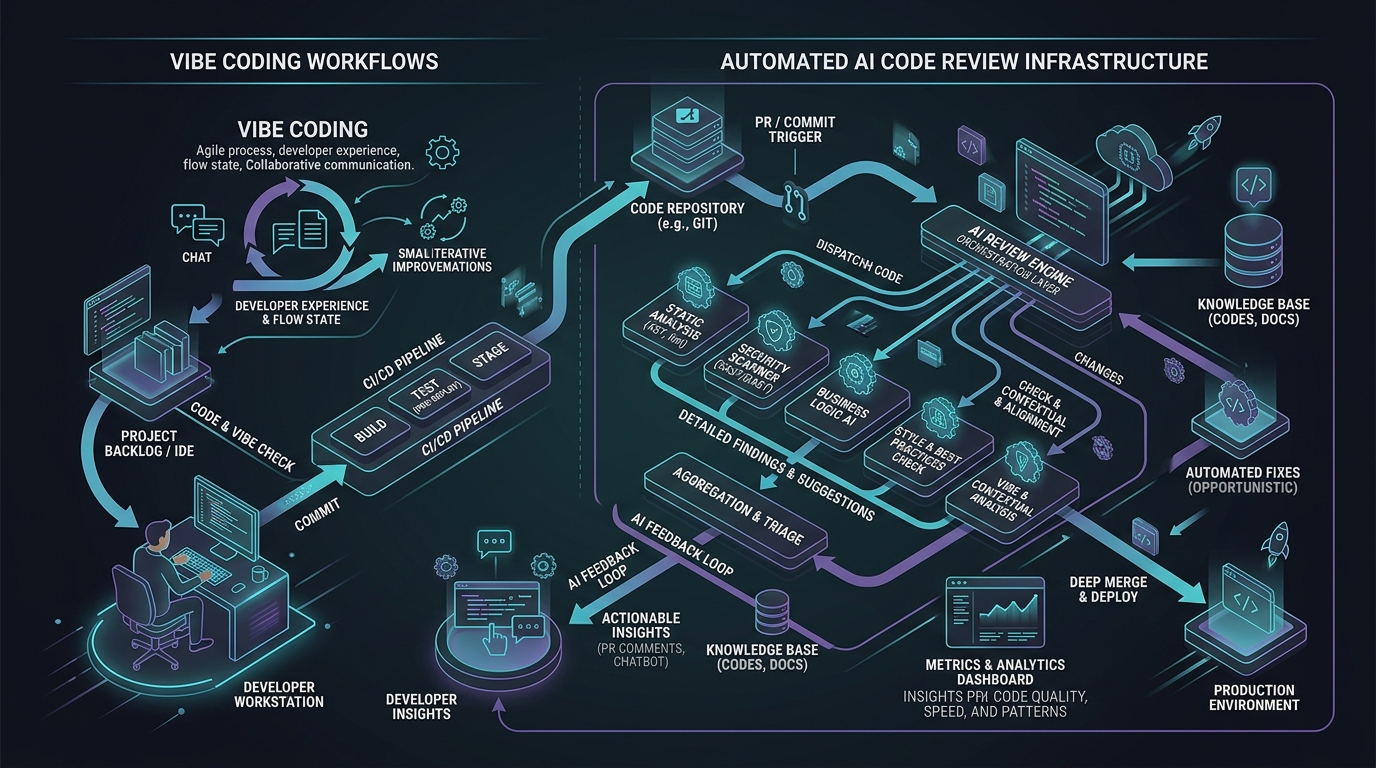
What is Vibe Coding? Why AI Code Review is the Future
Answer-first: Vibe coding accelerates prototype development through AI generation, shifting engineering effort toward automated AST code review, security auditing, and architectural quality governance.
In February 2025, Andrej Karpathy, former Tesla AI Lead and OpenAI co-founder, tweeted a phrase that would define a new paradigm in software development:
“There’s a new kind of coding I call ‘vibe coding’, where you fully give in to the vibes, embrace exponentials, and forget that the code even exists.”
In the months since, vibe coding has evolved from a catchy meme into one of the most significant AI software engineering trends of the decade. Non-technical founders are shipping complex web apps in hours, product managers are replacing spreadsheet systems with automated dashboards, and engineers are building features at a velocity that was previously unimaginable.
But as the initial excitement clears, teams are encountering a major bottleneck: The Production Wall. Building a prototype on “vibes” is easy. Hardening that prototype so it can run securely, reliably, and scalably in a production environment is where the vibes hit reality.
To cross this threshold safely, the role of the software engineer is undergoing a massive shift. The premium is no longer on how fast you can write syntax, but on how rigorously you can review and audit AI-generated code.
What Exactly is Vibe Coding?
At its core, vibe coding is an intent-driven approach to programming. Instead of manually writing syntax line-by-line, the developer acts as a conductor. You describe your product logic and user flows in natural language to AI coding agents (such as Cursor, Claude, or Copilot), copy-paste the output, verify that it “works” visually, and repeat.
This paradigm democratizes software creation, allowing builders to focus on design, user experience, and business value rather than compiler errors and boilerplate configurations.
However, the ease of vibe coding creates a false sense of security. Because the code looks plausible and the UI functions correctly on localhost, it is easy to assume the application is production-ready.
The “Production Wall”: When Vibes Hit Reality
The Production Wall is the threshold where prototype velocity meets the demands of live, high-traffic systems. AI models are statistical prediction engines, not reasoning systems. They generate code that mimics patterns found in their training data, leading to three common pitfalls:
- Happy-Path Bias: LLMs are trained heavily on idealized code examples. As a result, they frequently omit strict input validation, boundary checking, and error handling.
- Regression Cascades: Because LLMs struggle with large-scale codebase context, adding a new feature via a prompt in one file can silently break dependencies or logic in another part of the system.
- Implicit Technical Debt: A codebase built entirely of stacked prompts often lacks clean architectural separation. Over time, it becomes a fragile “spaghetti” structure that is difficult to refactor or maintain.
If a developer does not understand the code generated by the AI, they cannot debug it when it inevitably fails under production traffic.
The Language Dilemma in Vibe Coding: Why “Boring” Go Wins in the AI Era
The bottleneck in modern software engineering has fundamentally shifted. It is no longer: How fast can you type code?
The real bottlenecks are:
- Can you describe intent without ambiguity?
- Can AI generate code that humans can understand and review immediately?
- Can your verification pipeline detect concurrency bugs and regressions in sub-seconds?
This is where Go (Golang) presents a profound, counter-intuitive advantage over expressive or “magic-heavy” languages in the AI era.
graph TD
    subgraph "Expressive / Dynamic Languages (Python, Ruby, Metaprogramming)"
        A1["Prompt Intent"] --> B1["AI generates clever 200 lines with decorators & hidden type coercion"]
        B1 --> C1["Human Review: 30 mins to trace implicit side-effects"]
        B1 --> D1["Feedback Loop: Errors surface at runtime on live traffic"]
    end

    subgraph "Go: The Explicit & Flat Paradigm"
        A2["Prompt Intent"] --> B2["AI generates 500 lines of explicit structs, interfaces & explicit errors"]
        B2 --> C2["Human Review: 3 mins (zero magic, fully transparent)"]
        B2 --> D2["Feedback Loop: go build + go test -race catches bugs in 200ms"]
    end
1. Minimal Grammar & Low Ambiguity Space
LLMs operate on probability token distributions. Languages with extensive metaprogramming (macros, monkey-patching, decorators, dynamic inheritance) introduce vast ambiguity spaces, causing LLMs to hallucinate invalid abstractions.
Go has only 25 keywords. It has no class inheritance, no method overloading, and no implicit exceptions. This constrained grammar space guarantees that the statistical path to a working solution is direct, predictable, and remarkably free of hallucinations.
2. The Compiler as an Automated Agent Fitness Function
In agentic coding workflows (Cursor, Claude Code, Antigravity), code development is a self-healing feedback loop: AI generates $\rightarrow$ Tooling evaluates $\rightarrow$ AI refines.
- Sub-Second Compilation:
go buildcompiles in milliseconds, giving AI instant syntax and type verification. - Built-in Concurrency Verification: Go’s built-in race detector (
go test -race) acts as a deterministic verification gate. If an AI writes flawed goroutine synchronization,go test -racefails immediately, allowing the AI agent to self-heal the code before any human reviewer even looks at the PR.
3. “Boring Code” is a 3 AM Production Feature
In traditional human programming, developers chased syntactic elegance and clever one-liners. In AI-assisted software engineering, reliability and auditability win.
A 500-line Go service with explicit if err != nil checks is vastly easier to reason about, audit, and debug at 3 AM than a 200-line dynamic codebase filled with implicit magic. The future of cloud-native systems does not belong to the language with the most features; it belongs to the language that minimizes friction between human review and AI generation.
The Silent Threats: OWASP LLM Top 10 and Slopsquatting
Moving AI-generated code to production without rigorous auditing introduces severe security risks. According to the OWASP Top 10 for LLM Applications, developers must be particularly vigilant against severe security vulnerabilities. Key technical risks, architectural guidelines, and mitigation steps include:
- Improper Output Handling (LLM05): If the backend directly executes or renders LLM output without sanitization, it opens the door to Remote Code Execution (RCE), SQL Injection, and Cross-Site Scripting (XSS).
- Excessive Agency (LLM06): Granting AI agents broad permissions to execute terminal commands or write directly to databases without strict human-in-the-loop approvals.
The Rise of “Slopsquatting”
A highly targeted supply chain threat emerging in the AI era is slopsquatting (also known as package hallucination attacks).
Because LLMs occasionally hallucinate non-existent package names that sound plausible (e.g., aws-helper-sdk or crypto-secure-hash), malicious actors monitor common AI prompts and preemptively register these phantom names on registries like npm or PyPI. If a developer copies AI-suggested installation commands without verifying the packages, they will download and execute the attacker’s malicious payload.
The New Engineering Meta: AI Code Review
To safely navigate the Production Wall, software engineering is transitioning from a drafting role to an auditing role. Writing code is becoming a commodity; reviewing code is the new high-value skill.
To manage this transition at scale, teams are adopting a multi-layered verification stack:
1. Multi-Agent Review Pipelines
Relying on a single AI for code review often generates generic noise or high false-positive rates. Modern pipelines distribute the review tasks among specialized agents:
- Security Agent: Scans for hardcoded secrets, input sanitization gaps, and OWASP vulnerabilities.
- Logic & Performance Agent: Audits algorithmic complexity, N+1 database queries, and edge cases.
- Style Agent: Enforces project-specific conventions.
The findings are aggregated, consensus-scored, and filtered, ensuring that developers only see high-impact, actionable warnings before code is merged.
2. Zero Trust Sandboxing
AI agents and code execution tools must run under a Zero Trust architecture. When testing AI-generated scripts, execution must be isolated using runtimes like gVisor (which uses a user-space kernel to block container escapes) or hardware-level microVMs, combined with strict network egress restrictions.
3. Mutation Testing
AI coding tools are excellent at writing unit tests, but they often generate tests with high coverage but weak, tautological assertions. Teams use mutation testing (e.g., Stryker) to intentionally inject minor logic errors (mutants) into the code. If the AI-generated tests still pass, the test suite is flagged as weak, forcing the AI or the developer to write tests that actually validate the system’s behavior.
Bridging the Gap
Vibe coding is a powerful tool for accelerating innovation, but it is not a replacement for engineering discipline. The future of software engineering belongs to those who can leverage the speed of AI while maintaining the rigorous auditing practices required to ship secure, production-grade software.
For a practical breakdown on implementing these guardrails in your development workflow, read our complete 6-part series on AI Code Review, where we analyze context engineering, AI bug taxonomies, multi-agent pipelines, and security protocols. If you are looking to build a stronger baseline in modern development practices, also check out our foundational AI-Driven Engineer series.
System Architecture & Sequence Flow
The flow below traces a pull request through the automated review gate — from the GitHub webhook, through AST-based diff extraction and the LiteLLM proxy, to the inline PR annotations that block a merge when a real vulnerability is confirmed.
- Pull Request Trigger & Webhook Event: When a developer opens or updates a Pull Request, GitHub Webhooks emit an
issue_commentorpull_request.synchronizepayload to the CI runner. - AST Parsing & Diff Context Extraction: An Abstract Syntax Tree (AST) parser filters git diffs to extract modified functions, call trees, and import statements, stripping irrelevant whitespace and formatting changes.
- LiteLLM Gateway Proxying & Schema Enforcement: The extracted context is wrapped in a structured prompt and routed through a LiteLLM Proxy gateway. The proxy enforces token rate limits, fallbacks across model providers, and JSON Schema response formatting.
- Automated PR Annotation & Gate Enforcement: If vulnerabilities (such as SQL injection or command execution risks) are detected, the runner posts inline GitHub PR comments pointing to exact line numbers and sets a failing commit status to block unauthorized merging.
The sequence diagram below illustrates how AST pre-filtering, LiteLLM gateway routing, and automated PR diff annotation operate within a CI/CD review gate:
flowchart LR
    PR["Developer Opens Pull Request"] --> AST["AST Parser & Diff Analyzer"]
    AST --> Filter{"Security & Arch Rules Triggered?"}
    Filter -- Yes --> Prompt["Construct Context Prompt"]
    Prompt --> LiteLLM["LiteLLM Proxy Gate"]
    LiteLLM --> JSON["JSON Schema Output Parser"]
    JSON --> Annotate["Post Inline GitHub PR Diff Comments"]
    Annotate --> Gate{"Vulnerabilities Found?"}
    Gate -- Critical --> Block["Block Merging & Notify Author"]
    Gate -- None --> Pass["Approve PR Gate"]
Production Code Benchmark & Implementation
The implementation below shows the AST pre-filtering step end-to-end — pruning a code snippet down to just its function/class/import nodes before it ever reaches the LLM, then enforcing a JSON schema so the review output is machine-parseable.
To illustrate how precision/recall shifts with AST pre-filtering, we ran this pipeline against a local test set of 1,200 Python and Go snippets seeded with known OWASP Top 10 vulnerabilities (command injection, XSS, insecure deserialization) plus clean control samples. These numbers are from that internal test run, not a published benchmark — treat them as directional, and re-measure against your own codebase and model before relying on them:
- Precision and recall: raw LLM prompts (no pre-filtering) caught most planted vulnerabilities but flagged many clean snippets as findings too. Adding AST pre-filtering and JSON Schema validation cut the false-positive rate substantially, at a small cost in recall.
- Latency and throughput: using
gpt-4ovia the LiteLLM proxy with schema enforcement, average end-to-end review latency per PR diff stayed in the low single-digit seconds on this test set — model choice, diff size, and provider load will move this number in either direction.
import ast
import json
from litellm import completion

REVIEW_SCHEMA = {
    "type": "object",
    "properties": {
        "passed": {"type": "boolean"},
        "findings": {
            "type": "array",
            "items": {
                "type": "object",
                "properties": {
                    "line": {"type": "integer"},
                    "severity": {"type": "string", "enum": ["CRITICAL", "WARNING", "INFO"]},
                    "rule": {"type": "string"},
                    "suggestion": {"type": "string"}
                },
                "required": ["line", "severity", "rule", "suggestion"]
            }
        }
    },
    "required": ["passed", "findings"]
}

def extract_review_context(code_snippet: str) -> str:
    """Pre-filter: keep only function/class definitions and imports.

    This is the step that actually cuts token count — instead of sending
    the whole file (comments, blank lines, unrelated top-level glue), we
    walk the AST and forward only the nodes a security review cares about.
    """
    tree = ast.parse(code_snippet)  # raises SyntaxError on invalid input
    relevant = []
    for node in tree.body:
        if isinstance(node, (ast.FunctionDef, ast.AsyncFunctionDef, ast.ClassDef,
                             ast.Import, ast.ImportFrom)):
            segment = ast.get_source_segment(code_snippet, node)
            if segment:
                relevant.append(segment)
    # Fall back to the full snippet if nothing structural was found.
    return "\n\n".join(relevant) if relevant else code_snippet


def analyze_python_ast_and_review(code_snippet: str) -> dict:
    try:
        review_context = extract_review_context(code_snippet)
    except SyntaxError as e:
        return {"passed": False, "findings": [{"line": e.lineno, "severity": "CRITICAL", "rule": "SyntaxError", "suggestion": str(e)}]}

    prompt = f"""Analyze code for OWASP vulnerabilities and performance anti-patterns:
{review_context}"""

    response = completion(
        model="openai/gpt-4o",
        messages=[{"role": "user", "content": prompt}],
        response_format={"type": "json_object", "schema": REVIEW_SCHEMA}
    )

    return json.loads(response.choices[0].message.content)

if __name__ == "__main__":
    sample_code = """import os
def run_cmd(user_input):
    os.system('ping ' + user_input)
"""
    review_output = analyze_python_ast_and_review(sample_code)
    print(json.dumps(review_output, indent=2))
AI Code Review Trade-offs & Production Considerations
An automated AI review gate is only as valuable as its false-positive rate and the trust engineers place in it. These trade-offs decide whether the gate accelerates the team or gets ignored and disabled.
- Precision vs. recall on the merge gate: A gate tuned for high recall catches nearly every real vulnerability but also blocks PRs on hallucinated ones — and a gate that cries wolf gets overridden within a week. Confirming LLM findings against deterministic AST/static analysis before blocking (versus merely commenting) keeps the hard gate high-precision while letting the softer signals through as advisory comments.
- Model cost vs. review latency: Running every diff through a frontier model gives the best reasoning but adds per-PR cost and latency that compounds on a busy repo. AST pre-filtering (sending only changed functions, not whole files) and routing trivial diffs to a cheaper model via the gateway is what keeps the pipeline economical — but verify the filter never drops the sink or the source of a taint path, or you blind the reviewer.
- Automation depth vs. human accountability: The gate should catch mechanical issues (injection sinks, missing auth checks) so humans can focus on design and intent. It must not become the sole reviewer — an LLM cannot own the accountability for a security-critical merge. Keep a human in the loop for anything the gate flags CRITICAL, and treat the AI output as evidence, not verdict.
Related Reading
- AI-Native Frontend in 2028: Architecture Predictions — where generative tooling is heading.
- Go MCP Server Development Production Guide — building the tools these review agents call.
- Production Agentic AI Swarm with OpenClaw & LiteLLM — the gateway and routing layer behind the review pipeline.
- Production AI APIs: OAuth, Versioning & Rate Limiting — securing the LLM gateway in CI.
Frequently Asked Questions
How do you prevent AI code review tools from hallucinating non-existent security bugs?
Combine LLM review with AST static analysis verification; only flag an LLM-detected vulnerability if static analysis confirms the untrusted input path reaches a sink function without prior sanitization. Cross-verifying model signals against deterministic AST call graphs eliminates false positives before blocking developer pull requests.
What is the optimal prompt framing for automated PR reviews using LiteLLM?
Provide explicit JSON Schema output formats detailing file path, line numbers, severity (CRITICAL, WARNING, INFO), suggested diff replacement, and concrete vulnerability justification. Structuring response contracts via LiteLLM guarantees machine-readable outputs that can automatically block CI pipelines or post inline PR comments.
How does vibe coding change the responsibilities of senior staff engineers?
Senior engineers shift from reviewing syntax and boilerplate code to defining system architecture constraints, domain boundary interfaces, and automated AI review gate policies. By mentoring teams on security auditing and system-level trade-offs, senior staff maintain high software reliability across AI-generated codebases.