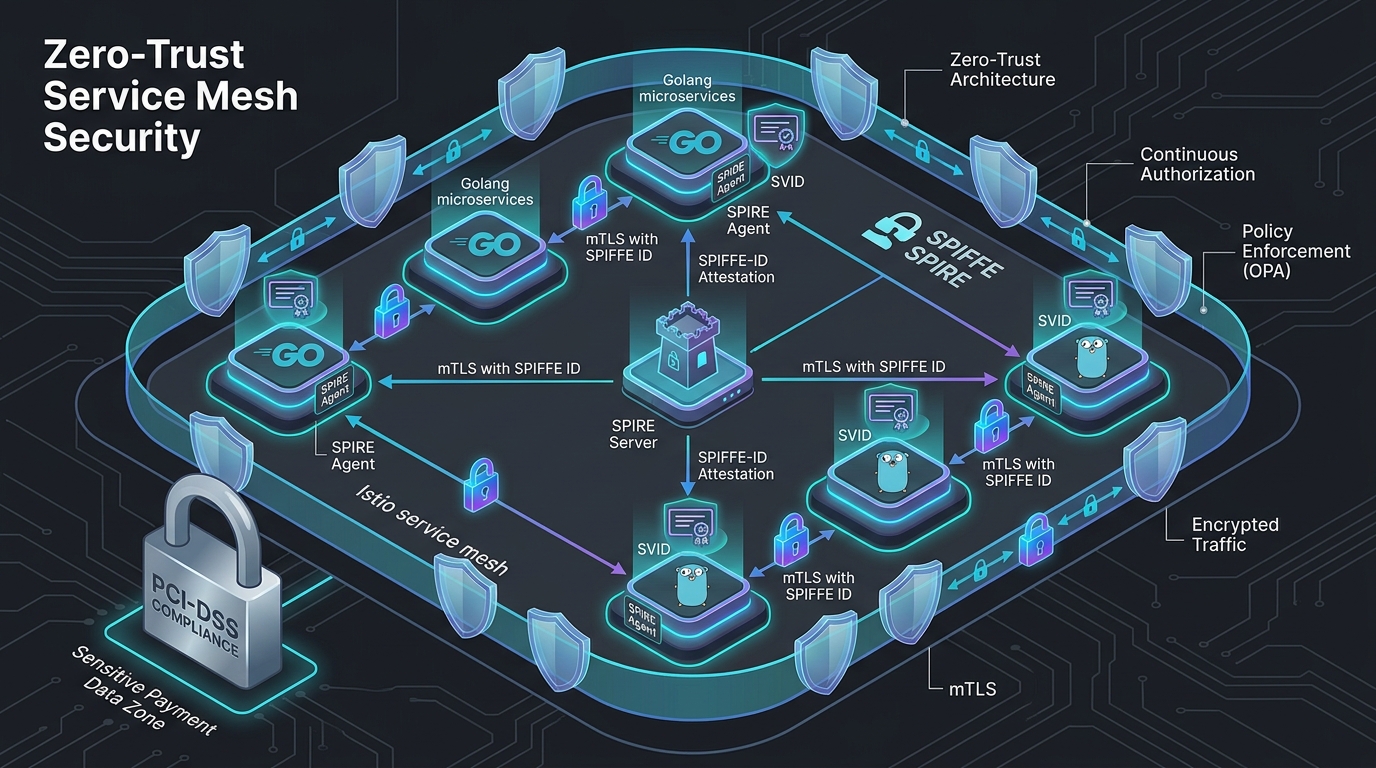
Zero-Trust Service Mesh Security in Go: SPIFFE/SPIRE & Istio
Answer-first: Zero-trust service mesh security in Go enforces cryptographic workload identities using SPIFFE/SPIRE kernel attestation (cgroups, namespaces, image digests) and Istio STRICT mTLS, eliminating static credentials. Rotating short-lived X.509 SVID certificates in memory every hour guarantees zero downtime, while fine-grained AuthorizationPolicy rules restrict inter-service communication to least-privilege paths complying with PCI-DSS 4.0 requirements.
Prerequisite: Production familiarity with Kubernetes ServiceAccount tokens, Linux kernel cgroups and process namespaces, TLS 1.3 mutual authentication handshakes, and Go 1.25 network programming with gRPC transport.
Introduction: The Zero-Trust Imperative in Modern Financial Microservices
Traditional perimeter security models relying on firewalls, Virtual Private Clouds, and static IP addresses fail to protect modern microservices processing sensitive payment data. Container IP addresses are ephemeral and static Kubernetes secrets risk exposure, so enterprise financial architectures need Zero-Trust models that cryptographically authenticate every inter-service communication.
The Payment Card Industry Data Security Standard version 4.0 (PCI-DSS 4.0) explicitly mandates stricter access controls, continuous identity attestation, automated key rotation, and cryptographic verification of all system components accessing the Cardholder Data Environment (CDE). Meeting these requirements demands a shift to a Zero-Trust Architecture (ZTA), where network locality confers zero trust: every service request must be explicitly authenticated, authorized based on strong workload identity, and encrypted in transit using short-lived cryptographic credentials.
This engineering guide provides a comprehensive production roadmap for constructing a Zero-Trust service mesh security architecture for high-throughput Golang microservices. We evaluate how the Secure Production Identity Framework for Everyone (SPIFFE) and its reference implementation SPIRE integrate with Istio Service Mesh and native Go gRPC/HTTP workloads to guarantee full compliance with PCI-DSS 4.0 standards.
Section 1: Architectural Foundations — SPIFFE/SPIRE Cryptographic Identity & Kernel Attestation
The Secure Production Identity Framework for Everyone (SPIFFE) and its reference implementation SPIRE issue short-lived X.509 certificates to Go microservices by performing secretless kernel and container attestation over local UNIX domain sockets.
1.1 Anatomy of a SPIFFE ID and SVID
SPIFFE defines a standardized Uniform Resource Identifier (URI) structure that serves as a workload identity:
spiffe://<trust-domain>/ns/<namespace>/sa/<service-account-name>
For example, a Go-based Payment Processing microservice operating within a PCI-DSS 4.0 compliant production environment carries the following SPIFFE ID:
spiffe://cde.prod.bank.internal/ns/payment-system/sa/payment-api-sa
This SPIFFE ID is encoded directly inside the Subject Alternative Name (SAN) extension of a short-lived X.509 certificate known as a SPIFFE Verifiable Identity Document (SVID).
+-----------------------------------------------------------------------+
|                        X.509 SVID Certificate                         |
+-----------------------------------------------------------------------+
| Subject: CN=payment-api.payment-system.svc                            |
| Subject Alternative Name (SAN):                                       |
|   - URI: spiffe://cde.prod.bank.internal/ns/payment-system/sa/pay...  |
| Issuer: CN=SPIRE Server Intermediate CA                               |
| Validity: Not Before: 2026-07-23T08:00:00Z                           |
|           Not After:  2026-07-23T09:00:00Z  (1-Hour Lifespan)         |
| Public Key: Elliptic Curve NIST P-256 (ECDSA)                         |
+-----------------------------------------------------------------------+
1.2 Kernel & Workload Attestation Mechanics
Unlike traditional identity systems where a process reads a secret token from a configuration file or environment variable, SPIFFE/SPIRE utilizes Secretless Workload Attestation. A microservice does not possess initial credentials; instead, it asks the local SPIRE Agent running on the host node for its identity. The SPIRE Agent verifies the process identity by interrogating the underlying host operating system kernel and Kubernetes API.
The attestation process involves two distinct stages:
- Node Attestation: The SPIRE Agent proves its own identity to the central SPIRE Server using node-level cryptographic anchors (e.g., TPM 2.0 chips, AWS Instance Identity Documents, or Kubernetes Projected Service Account Tokens).
- Workload Attestation: When a Go application connects to the local SPIRE Agent over a UNIX domain socket (
/tmp/spire-agent/public/api.sock), the agent inspects the calling process using OS kernel primitives:- Linux CGroups & Process ID (PID): Inspects
/proc/<pid>/cgroupand/proc/<pid>/statusto discover the exact Process ID, Linux User ID (UID), and Group ID (GID). - Kubernetes Kubelet API: Maps the PID to the container runtime ID, querying the local Kubelet to verify the Pod’s namespace, ServiceAccount name, Pod UID, and container labels.
- Container Image SHA256 Digest: Verifies the immutable image digest of the container running the process against registration entries configured in the SPIRE Server.
- Linux CGroups & Process ID (PID): Inspects
If an unauthorized process or altered container binary attempts to open the SPIRE Workload API UNIX socket, the selectors will fail to match, and the SPIRE Agent will refuse to issue an SVID.
sequenceDiagram
    autonumber
    participant App as Go Application (Payment API)
    participant Agent as SPIRE Agent (Host Unix Socket)
    participant Kernel as Linux Kernel / Kubelet API
    participant Server as SPIRE Server (Root CA)

    App->>Agent: 1. Request X.509 SVID over unix:///tmp/spire-agent/public/api.sock
    Agent->>Kernel: 2. Inspect Unix socket caller PID (/proc/<pid>/cgroup & Kubelet API)
    Kernel-->>Agent: 3. Return Process Metadata (UID, Namespace: payment-system, SA: payment-api-sa, Image Digest)
    Agent->>Server: 4. Match Attestation Selectors against SPIRE Registration Database
    Server-->>Agent: 5. Issue short-lived X.509 SVID (1-hour validity) signed by Trust Domain CA
    Agent-->>App: 6. Stream X.509 SVID, Private Key & CA Trust Bundle to Go memory
1.3 In-Memory SVID Lifecycles and Revocation vs. Short Lifetimes
Traditional Public Key Infrastructure (PKI) relies on Certificate Revocation Lists (CRLs) or Online Certificate Status Protocol (OCSP) stapling to invalidate compromised certificates. In dynamic cloud-native environments, CRLs are prone to stale caches and OCSP endpoints create severe latency bottlenecks and availability single-points-of-failure.
SPIFFE solves certificate revocation by enforcing Ultra Short-Lived Certificates (typically 1 hour down to 15 minutes). Instead of managing complex revocation infrastructure:
- SPIRE Agents automatically re-issue and push updated X.509 SVIDs to workloads when certificates reach 50% of their total lifespan (e.g., every 30 minutes for a 1-hour cert).
- If a workload is compromised or evicted, its certificate naturally expires within minutes, rendering exfiltrated certificates useless to attackers.
- If a intermediate CA key is compromised, SPIRE Server issues a updated Trust Bundle across all nodes. The SPIRE Agent immediately streams the new Trust Bundle to workloads over the Workload API socket, forcing immediate invalidation of old CA signatures.
Section 2: Implementing Zero-Trust Workloads in Go using go-spiffe/v2
Using the official go-spiffe/v2 SDK, software engineers can establish mutual TLS connections, stream in-memory SVID certificate updates dynamically, and enforce strict SPIFFE ID Subject Alternative Name authorization checks across gRPC and HTTP microservices.
2.1 SPIFFE Workload API Integration in Go
Connecting a production-grade Go application to the local SPIRE Agent UNIX domain socket requires initializing an X509Source background watcher to continuously refresh certificate chains in memory. The Go implementation below manages socket connections and tracks certificate expiration:
package spiffeutil

import (
	"context"
	"fmt"
	"os"
	"time"

	"github.com/spiffe/go-spiffe/v2/spiffeid"
	"github.com/spiffe/go-spiffe/v2/workloadapi"
)

// WorkloadManager manages the lifecycle of SPIFFE Workload API connections.
type WorkloadManager struct {
	x509Source *workloadapi.X509Source
	trustDomain spiffeid.TrustDomain
}

// NewWorkloadManager creates and starts a SPIFFE X509Source watcher.
func NewWorkloadManager(ctx context.Context, socketPath string, trustDomainStr string) (*WorkloadManager, error) {
	if socketPath == "" {
		socketPath = "unix:///tmp/spire-agent/public/api.sock"
	}

	td, err := spiffeid.TrustDomainFromString(trustDomainStr)
	if err != nil {
		return nil, fmt.Errorf("invalid trust domain format '%s': %w", trustDomainStr, err)
	}

	// Initialize the X509Source with explicit Unix domain socket address
	source, err := workloadapi.NewX509Source(
		ctx,
		workloadapi.WithClientOptions(
			workloadapi.WithAddr(socketPath),
		),
	)
	if err != nil {
		return nil, fmt.Errorf("failed to create SPIFFE X509Source from socket %s: %w", socketPath, err)
	}

	// Verify that we successfully fetched a valid SVID on startup
	svid, err := source.GetX509SVID()
	if err != nil {
		source.Close()
		return nil, fmt.Errorf("failed to fetch initial X.509 SVID: %w", err)
	}

	fmt.Fprintf(os.Stdout, "[SPIFFE-INIT] Successfully attested! Workload SPIFFE ID: %s (Expires: %s)\n",
		svid.ID.String(), svid.Certificates[0].NotAfter.Format(time.RFC3339))

	return &WorkloadManager{
		x509Source:  source,
		trustDomain: td,
	}, nil
}

// X509Source returns the underlying source for TLS configuration.
func (m *WorkloadManager) X509Source() *workloadapi.X509Source {
	return m.x509Source
}

// TrustDomain returns the configured trust domain.
func (m *WorkloadManager) TrustDomain() spiffeid.TrustDomain {
	return m.trustDomain
}

// Close gracefully releases socket connections and background watchers.
func (m *WorkloadManager) Close() error {
	if m.x509Source != nil {
		return m.x509Source.Close()
	}
	return nil
}
2.2 Production Go gRPC Server with SPIFFE mTLS & SAN Verification
In a PCI-DSS 4.0 CDE, services must never accept unencrypted connections or unauthenticated clients. The following implementation configures a production Go gRPC server using spiffetls that mandates mutual TLS and checks that incoming clients present a SPIFFE ID belonging to authorized service accounts.
package server

import (
	"context"
	"errors"
	"fmt"
	"net"
	"os"

	"github.com/spiffe/go-spiffe/v2/spiffeid"
	"github.com/spiffe/go-spiffe/v2/spiffetls/tlsconfig"
	"github.com/spiffe/go-spiffe/v2/workloadapi"
	"google.golang.org/grpc"
	"google.golang.org/grpc/credentials"
	"google.golang.org/grpc/codes"
	"google.golang.org/grpc/status"
	"google.golang.org/grpc/peer"
)

// AllowedClients defines the set of explicit SPIFFE IDs permitted to invoke Card Vault RPCs.
var AllowedClients = map[string]bool{
	"spiffe://cde.prod.bank.internal/ns/payment-system/sa/payment-api-sa": true,
	"spiffe://cde.prod.bank.internal/ns/settlement/sa/batch-settlement-sa":  true,
}

// SPIFFEAuthInterceptor verifies incoming client SPIFFE IDs on every gRPC method invocation.
func SPIFFEAuthInterceptor(ctx context.Context, req interface{}, info *grpc.UnaryServerInfo, handler grpc.UnaryHandler) (interface{}, error) {
	p, ok := peer.FromContext(ctx)
	if !ok || p.AuthInfo == nil {
		return nil, status.Error(codes.Unauthenticated, "missing peer authentication context")
	}

	tlsInfo, ok := p.AuthInfo.(credentials.TLSInfo)
	if !ok || len(tlsInfo.State.PeerCertificates) == 0 {
		return nil, status.Error(codes.Unauthenticated, "peer certificates absent in TLS handshake")
	}

	clientCert := tlsInfo.State.PeerCertificates[0]
	clientID, err := spiffeid.FromX509Cert(clientCert)
	if err != nil {
		return nil, status.Errorf(codes.Unauthenticated, "failed to extract SPIFFE ID from client cert SAN: %v", err)
	}

	if !AllowedClients[clientID.String()] {
		fmt.Fprintf(os.Stderr, "[SECURITY-ALERT] Unauthorized access attempt by SPIFFE ID: %s on RPC: %s\n", clientID.String(), info.FullMethod)
		return nil, status.Errorf(codes.PermissionDenied, "SPIFFE ID '%s' is not authorized to access endpoint '%s'", clientID.String(), info.FullMethod)
	}

	// Inject validated SPIFFE ID into context for downstream logging / auditing
	ctx = context.WithValue(ctx, "authenticated_spiffe_id", clientID.String())
	return handler(ctx, req)
}

// StartGRPCVaultServer launches the gRPC server secured with SPIFFE mTLS.
func StartGRPCVaultServer(ctx context.Context, port string, x509Source *workloadapi.X509Source, trustDomain spiffeid.TrustDomain) error {
	listener, err := net.Listen("tcp", ":"+port)
	if err != nil {
		return fmt.Errorf("failed to bind port %s: %w", port, err)
	}

	// Authorize any client within our Trust Domain at the TLS layer; granular RPC check happens in interceptor.
	authorizer := tlsconfig.AuthorizeTrustDomain(trustDomain)

	// Construct server TLS configuration using dynamic X509Source
	tlsConfig := tlsconfig.MTLSServerConfig(x509Source, x509Source, authorizer)

	grpcOpts := []grpc.ServerOption{
		grpc.Creds(credentials.NewTLS(tlsConfig)),
		grpc.UnaryInterceptor(SPIFFEAuthInterceptor),
	}

	grpcServer := grpc.NewServer(grpcOpts...)

	// Register Vault payment services here (e.g. pb.RegisterCardVaultServer(grpcServer, vaultImpl))
	fmt.Printf("[VAULT-SERVER] Listening securely on :%s with SPIFFE mTLS (Trust Domain: %s)\n", port, trustDomain.String())

	go func() {
		<-ctx.Done()
		fmt.Println("[VAULT-SERVER] Shutting down gRPC server gracefully...")
		grpcServer.GracefulStop()
	}()

	if err := grpcServer.Serve(listener); err != nil && !errors.Is(err, grpc.ErrServerStopped) {
		return fmt.Errorf("gRPC server abnormal exit: %w", err)
	}

	return nil
}
2.3 Production Go gRPC Client with SPIFFE mTLS Dialing
The client service (e.g., Payment API) must dial the Card Vault service while enforcing that the server presents an exact, expected SPIFFE ID. This prevents Man-in-the-Middle (MITM) attacks and DNS spoofing in the cluster.
package client

import (
	"context"
	"fmt"
	"time"

	"github.com/spiffe/go-spiffe/v2/spiffeid"
	"github.com/spiffe/go-spiffe/v2/spiffetls/tlsconfig"
	"github.com/spiffe/go-spiffe/v2/workloadapi"
	"google.golang.org/grpc"
	"google.golang.org/grpc/credentials"
)

// DialVaultService establishes a secure gRPC connection enforcing exact server SPIFFE ID verification.
func DialVaultService(ctx context.Context, serverAddr string, x509Source *workloadapi.X509Source, expectedServerSPIFFEID string) (*grpc.ClientConn, error) {
	serverID, err := spiffeid.FromString(expectedServerSPIFFEID)
	if err != nil {
		return nil, fmt.Errorf("invalid expected server SPIFFE ID string '%s': %w", expectedServerSPIFFEID, err)
	}

	// Authorize explicit SPIFFE ID match for the remote server certificate SAN
	authorizer := tlsconfig.AuthorizeID(serverID)

	// Create TLS client configuration automatically deriving CA bundles and client SVID from X509Source
	tlsConfig := tlsconfig.MTLSClientConfig(x509Source, x509Source, authorizer)

	dialCtx, cancel := context.WithTimeout(ctx, 10*time.Second)
	defer cancel()

	conn, err := grpc.DialContext(
		dialCtx,
		serverAddr,
		grpc.WithTransportCredentials(credentials.NewTLS(tlsConfig)),
		grpc.WithBlock(),
	)
	if err != nil {
		return nil, fmt.Errorf("failed to dial vault service at %s with SPIFFE identity verification: %w", serverAddr, err)
	}

	fmt.Printf("[CLIENT] Connected securely to Vault Service at %s (Validated SPIFFE ID: %s)\n", serverAddr, serverID.String())
	return conn, nil
}
2.4 Production Go HTTP Middleware for SPIFFE Identity Authorization
For HTTP microservices and RESTful endpoints processing cardholder data, the following Net/HTTP middleware intercepts incoming requests, extracts the client’s SPIFFE ID from peer certificates, and enforces access control.
package httpsec

import (
	"context"
	"net/http"
	"os"

	"github.com/spiffe/go-spiffe/v2/spiffeid"
)

type contextKey string

const AuthenticatedSPIFFEIDKey contextKey = "spiffe_id"

// RequireSPIFFEIDMiddleware enforces mTLS client certificate presence and verifies the SPIFFE ID against allowed rules.
func RequireSPIFFEIDMiddleware(allowedSPIFFEIDs map[string]bool, next http.Handler) http.Handler {
	return http.HandlerFunc(func(w http.ResponseWriter, r *http.Request) {
		if r.TLS == nil || len(r.TLS.PeerCertificates) == 0 {
			http.Error(w, `{"error":"Forbidden: Mutual TLS certificate required"}`, http.StatusForbidden)
			return
		}

		peerCert := r.TLS.PeerCertificates[0]
		id, err := spiffeid.FromX509Cert(peerCert)
		if err != nil {
			http.Error(w, `{"error":"Unauthorized: Invalid SPIFFE ID in certificate SAN"}`, http.StatusUnauthorized)
			return
		}

		spiffeStr := id.String()
		if !allowedSPIFFEIDs[spiffeStr] {
			fmt.Fprintf(os.Stderr, "[HTTP-SECURITY] Refused request from unauthorized SPIFFE ID: %s to path: %s\n", spiffeStr, r.URL.Path)
			http.Error(w, `{"error":"Unauthorized: Service identity not permitted"}`, http.StatusUnauthorized)
			return
		}

		// Attach verified SPIFFE ID to context
		ctx := context.WithValue(r.Context(), AuthenticatedSPIFFEIDKey, spiffeStr)
		next.ServeHTTP(w, r.WithContext(ctx))
	})
}
The sequence diagram below traces SPIFFE mTLS handshake and validation:
sequenceDiagram
    autonumber
    participant Client as Payment API (Go Client)
    participant Server as Card Vault (Go Server)
    participant Watcher as SPIFFE X509Source

    Client->>Server: 1. Initiate TLS 1.3 Handshake (Offer Client Certificate)
    Server->>Watcher: 2. Query Active CA Trust Bundle from memory
    Watcher-->>Server: 3. Return dynamic Trust Bundle
    Server->>Server: 4. Validate Client Cert Signature & Expiry
    Server->>Server: 5. Extract SAN URI (spiffe://cde.prod/ns/payment-system/sa/payment-api-sa)
    Server->>Server: 6. Match SPIFFE ID against Allowed Clients Matrix
    Server-->>Client: 7. Handshake Complete -> Establish Encrypted Session
Section 3: Istio Service Mesh & SPIFFE/SPIRE Integration for PCI-DSS 4.0
Mounting SPIRE Agent UNIX sockets into Envoy sidecars lets Istio enforce STRICT mTLS and role-based access policies across heterogeneous Kubernetes deployments, which helps satisfy PCI-DSS 4.0 security mandates.
3.1 Custom CA Integration: Istiod and SPIRE Workload API
By default, Istio’s control plane (istiod) acts as its own Certificate Authority (CA) issuing short-lived certificates to Envoy sidecars. However, for PCI-DSS 4.0 compliance across heterogeneous workloads (combining K8s containers, bare-metal servers, and multi-cloud nodes), Istio can be configured to delegate workload identity attestation directly to SPIRE.
Envoy sidecars mount the SPIRE Agent UNIX domain socket via a hostPath volume. Istio Envoy SDS (Secret Discovery Service) connects directly to SPIRE over socket (unix:///run/spire/sockets/agent.sock) to fetch SVID certificates, entirely bypassing istiod CA issuance. The diagram below illustrates Envoy sidecar socket mounting and SDS certificate streaming.
+-----------------------------------------------------------------------------------+
|                                 Kubernetes Pod                                    |
|                                                                                   |
|  +-----------------------------------+     +-----------------------------------+  |
|  |     Application Container         |     |       Istio Envoy Sidecar         |  |
|  |      (Payment Go Service)         |     |         (Proxy Engine)            |  |
|  +-----------------+-----------------+     +-----------------+-----------------+  |
|                    |                                         |                    |
|                    |  Local App SVID                         |  Proxy SVID        |
|                    |  (gRPC mTLS)                            |  (Mesh mTLS)       |
|                    v                                         v                    |
|  +-----------------------------------------------------------------------------+  |
|  | Volume Mount: unix:///run/spire/sockets/agent.sock                          |  |
|  +-------------------------------------+---------------------------------------+  |
+----------------------------------------|------------------------------------------+
                                         v
+-----------------------------------------------------------------------------------+
|                        SPIRE Agent DaemonSet (Host Node)                          |
+-----------------------------------------------------------------------------------+
3.2 Enforcing STRICT mTLS with Istio PeerAuthentication
PCI-DSS 4.0 Requirement 4.2 dictates that all technical communications transmitting cardholder data over internal networks must be strongly encrypted. Istio’s PeerAuthentication custom resource ensures that plain-text HTTP or unencrypted TCP traffic is immediately dropped by Envoy proxy listeners. The Kubernetes manifest below configures STRICT mTLS across the target namespace:
apiVersion: security.istio.io/v1beta1
kind: PeerAuthentication
metadata:
  name: default-strict-mtls
  namespace: payment-cde
spec:
  mtls:
    mode: STRICT
3.3 Service-to-Service Authorization with Istio AuthorizationPolicy
PCI-DSS 4.0 Requirements 7.2 and 8.2 demand that access to system components be explicitly restricted based on business need-to-know and verifiable identity.
The following Istio AuthorizationPolicy permits ONLY the payment-api service account to issue HTTP POST requests to /v1/cards/tokenize on the card-vault service. All other traffic—even from services inside the same cluster—is rejected with an HTTP 403 Forbidden.
apiVersion: security.istio.io/v1beta1
kind: AuthorizationPolicy
metadata:
  name: card-vault-rbac
  namespace: payment-cde
spec:
  selector:
    matchLabels:
      app: card-vault-service
  action: ALLOW
  rules:
  - from:
    - source:
        principals: ["spiffe://cde.prod.bank.internal/ns/payment-cde/sa/payment-api-sa"]
    to:
    - operation:
        methods: ["POST", "GET"]
        paths: ["/v1/cards/tokenize", "/v1/cards/detokenize"]
---
apiVersion: security.istio.io/v1beta1
kind: AuthorizationPolicy
metadata:
  name: card-vault-deny-all
  namespace: payment-cde
spec:
  selector:
    matchLabels:
      app: card-vault-service
  action: DENY
  rules:
  - from:
    - source:
        notPrincipals: ["spiffe://cde.prod.bank.internal/ns/payment-cde/sa/payment-api-sa"]
The sequence diagram below traces dynamic SVID certificate hot-reloading and context updates inside Envoy proxy memory without dropping active TCP connections.
sequenceDiagram
    autonumber
    participant Watcher as SPIRE Agent Socket Stream
    participant SDS as Envoy Secret Discovery Service (SDS)
    participant Listener as Envoy Inbound TLS Listener
    participant App as Go Payment Microservice

    Watcher->>SDS: 1. Stream updated X.509 SVID (cert + key) prior to expiry
    SDS->>Listener: 2. Hot-reload Active TLS Context in Envoy memory (Zero Downtime)
    Listener->>Listener: 3. Atomically replace SSL_CTX pointer
    Note over Listener: In-flight requests continue on active TLS sessions
    App->>Listener: 4. Next inbound TCP connection performs TLS handshake with updated SVID
Section 4: PCI-DSS 4.0 Requirement-by-Requirement Compliance Mapping
The compliance matrix below maps SPIFFE/SPIRE workload attestation, Istio mTLS mesh encryption, short-lived SVID key rotation, and cryptographically verifiable audit logging to specific PCI-DSS 4.0 cardholder data environment requirements.
| PCI-DSS 4.0 Requirement | Title & Core Compliance Objective | Zero-Trust SPIFFE/SPIRE & Istio Implementation | Architectural Compliance Proof |
|---|---|---|---|
| Req 3.4 / 3.5 | Protect stored Account Data & SAD access | Restricts access to encryption keys and PAN vault microservices using cryptographic SPIFFE ID RBAC. | Access to key material and tokenization microservices is limited to explicit SPIFFE principals via Istio AuthorizationPolicy. |
| Req 4.2 | Strong Cryptography in Transit | Enforces TLS 1.3 mTLS for all inter-service communications within and across namespaces. | Istio PeerAuthentication (STRICT mode) combined with Go spiffetls guarantees 100% encrypted traffic with cipher suites >= TLS_AES_256_GCM_SHA384. |
| Req 6.4 | Public/Internal App Security & Isolation | Prevents lateral movement from compromised containers or unauthorized binaries. | Secretless Workload Attestation evaluates Linux cgroups and container image SHA digests. Unattested binaries cannot acquire SVIDs. |
| Req 7.2 & 7.3 | Access Control & Least Privilege | Grants access strictly based on business need-to-know authenticated identities. | Service-to-service communication is governed by explicit SPIFFE ID SAN matches, replacing wildcard IP subnet rules with granular URI identity policies. |
| Req 8.2 & 8.3 | Strong Workload Authentication | Authenticates all system component access using verifiable identity credentials. | Static API tokens and hardcoded database passwords are replaced by short-lived X.509 SVIDs (1-hour lifespan) issued via local Unix sockets. |
| Req 10.2 & 10.3 | Audit Logging & Non-Repudiation | Captures individual identity in all system component access logs. | Envoy proxy and Go gRPC interceptors record the verified client SPIFFE ID in all access logs, creating cryptographically verifiable audit trails. |
| Req 12.3 & 12.10 | Operational Risk & Key Lifecycle | Automates key management, rotation, and vulnerability mitigation. | SPIRE Server automates CA key updates and SVID rotation every 30 minutes in-memory without manual human intervention or downtime. |
Section 5: Production Operational Edge Cases & Troubleshooting Guide
Running SPIFFE/SPIRE and Istio in production surfaces a few recurring operational edge cases: UNIX domain socket disconnect resilience, TLS 1.3 session resumption latency, and multi-region trust domain federation.
5.1 SPIRE Agent Socket Disconnection & Fallback Resilience
Problem: Under extreme node memory pressure or during a SPIRE Agent DaemonSet rolling upgrade, the UNIX domain socket /tmp/spire-agent/public/api.sock may temporarily become unreachable.
Mitigation:
- The
go-spiffe/v2SDKX509Sourceautomatically caches the most recently fetched valid SVID and Trust Bundle in memory. - If the UNIX socket disconnects,
X509Sourceenters a retry background backoff loop while continuing to serve the cached SVID for incoming/outgoing TLS handshakes until the certificate expires. - Grace Period Sizing: Set SVID TTL to 1 hour with rotation attempted at 30 minutes. This provides a 30-minute operational buffer for SPIRE Agent restarts or node network blips without impacting microservice traffic.
5.2 Latency Optimization of In-Memory TLS Handshakes
Problem: Re-establishing full TLS 1.3 handshakes on every microservice RPC introduces CPU overhead and connection latency.
Mitigation:
- Enable gRPC HTTP/2 Multiplexing and persistent connection pooling.
- A single SPIFFE mTLS handshake is performed when opening the gRPC channel; thousands of subsequent RPC requests stream across the multiplexed connection without re-triggering TLS handshakes.
- When
X509Sourcereceives a rotated SVID, existing active HTTP/2 TCP connections remain open and unaffected. New connections created after rotation immediately utilize the updated SVID.
5.3 SPIFFE Trust Domain Federation for Multi-Cloud & Cross-Region PCI-DSS
For financial applications spanning multiple cloud providers (e.g., AWS CDE and Google Cloud CDE), workload identities reside in distinct Trust Domains:
spiffe://aws.cde.bank.internalspiffe://gcp.cde.bank.internal
SPIRE Server supports Trust Domain Federation. The AWS SPIRE Server and GCP SPIRE Server securely exchange their Root CA Public Keys over HTTPS using the SPIFFE Federation API (/.well-known/spiffe-bundle). This allows a Go service in AWS to validate the SVID presented by a GCP service without sharing private keys or centralizing the Certificate Authority.
Frequently Asked Questions
What is the distinction between a SPIFFE ID and a SPIFFE Verifiable Identity Document (SVID)?
How does SPIRE kernel attestation prevent rogue containers from impersonating legitimate workloads?
How can Go gRPC services rotate X.509 SVID certificates without dropping active TCP connections?
Can SPIRE integrate directly with Envoy and replace Istiod internal Certificate Authorities?
What are the explicit requirements of PCI-DSS 4.0 regarding microservice inter-communication security?
Section 7: Conclusion & PCI-DSS 4.0 Zero-Trust Architecture Checklist
Replacing static network security with cryptographic workload identity is the single most effective architecture pattern for satisfying PCI-DSS 4.0 compliance in modern cloud-native systems. By combining SPIFFE/SPIRE kernel attestation with native Go spiffe-golang SDK enforcing mTLS and Istio Envoy sidecar authorization policies, security teams eliminate secret sprawl, automate key rotation, and guarantee end-to-end non-repudiable audit logging.
PCI-DSS 4.0 Zero-Trust Production Audit Checklist
Use this 10-point checklist before submitting your microservices architecture for QSA (Qualified Security Assessor) PCI-DSS 4.0 audit:
- 1. Secretless Workload Attestation: Confirm all microservices fetch credentials dynamically over local UNIX domain sockets without reading static passwords or tokens from disks or environment variables.
- 2. Linux CGroup & Image Digest Matching: Ensure SPIRE registration entries enforce
container:image-idSHA256 digests andk8s:saselectors to prevent rogue image executions. - 3. Short-Lived SVID Lifetimes: Configure X.509 SVID TTL to <= 1 hour (recommended: 30–60 minutes) with dynamic in-memory rotation triggered at 50% lifespan.
- 4. Global STRICT mTLS Enforcement: Apply Istio
PeerAuthenticationwithmode: STRICTacross all namespaces inside the Cardholder Data Environment (CDE). - 5. Explicit SPIFFE ID Authorization: Verify that all Go gRPC interceptors and Istio
AuthorizationPolicymanifests validate exact SAN URIs (spiffe://<trust-domain>/ns/.../sa/...). - 6. TLS 1.3 & Strong Cipher Suites: Restrict TLS configurations to TLS 1.3 or TLS 1.2 with ECDHE key exchange and AES-GCM / ChaCha20-Poly1305 ciphers (PCI-DSS Req 4.2).
- 7. Cryptographic Audit Trail Integration: Confirm Envoy access logs and Go application logs write the peer SPIFFE ID into structured audit logs for every transaction (PCI-DSS Req 10.2).
- 8. SPIRE Agent Resilience: Set hostPath UNIX socket permissions to
0770owned by dedicated security groups, ensuring unauthorized non-root host processes cannot connect to the socket. - 9. Multi-Region Trust Federation: If operating across regions or clouds, verify SPIFFE Trust Domain Federation bundle exchange is secured via HTTPS and mutual CA verification.
- 10. Disaster & Key Compromise Plan: Test intermediate CA key rotation in SPIRE Server to confirm new Trust Bundles propagate to all running Go services within 60 seconds.
Related Reading
- Anchor Pillar: Zero-Trust Service Mesh Security Guide — core cryptographic identity architecture.
- Go Microservices: Go Microservices Architecture: Production Guide — scalable RPC patterns and clean architecture.
- System Architecture: System Architecture Reading Map — foundational patterns for enterprise engineering.
- Banking Architecture: Banking Microservices Architecture: Event Sourcing & High Availability — PCI-DSS transaction systems.
- E-Commerce Systems: Architecting 21-Service E-commerce with Golang & DDD — domain-driven microservice platforms.
- Golang gRPC Microservices: Protobuf, TLS & Middleware — the gRPC interceptors that enforce SPIFFE ID authorization.
- GitOps at Scale: Kubernetes & ArgoCD — deploying
PeerAuthenticationandAuthorizationPolicymanifests safely. - Multi-region Geo-distributed API Routing — the cross-region context for SPIFFE trust-domain federation.